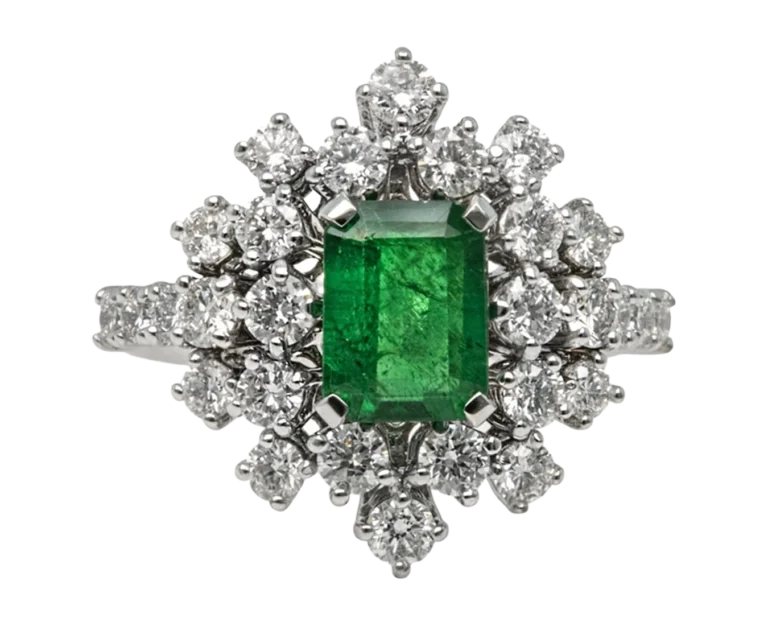
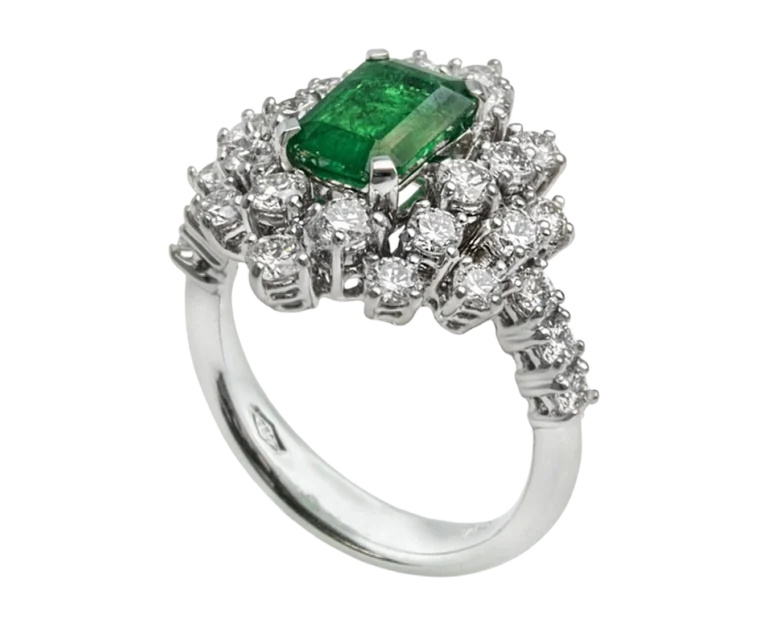
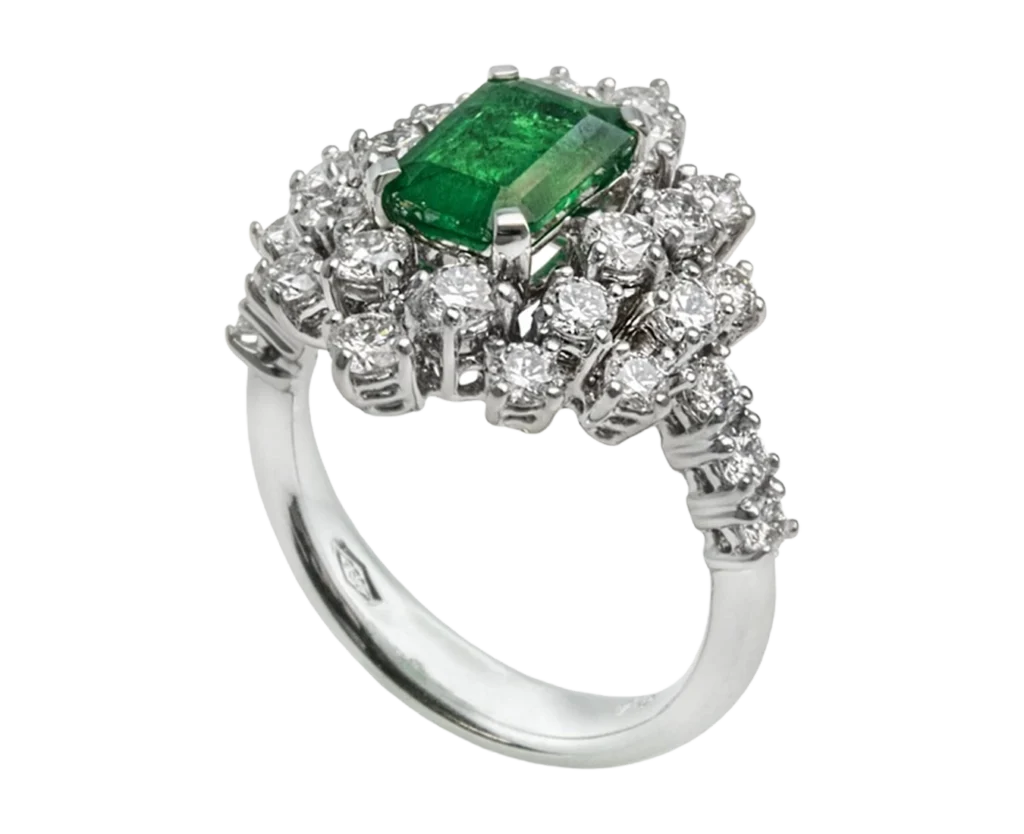
Mimosa is a bespoke 18-carat white gold ring with natural emerald octagon-cut and natural diamonds.
The composition develops symmetrically around the central gemstone. The diamonds build an articulated crown that continues towards the shoulders of the shank, while prongs, settings and basket participate in a single structure.
The project does not focus solely on the front of the ring. The profile, the height of the gemstone, the relationship between the basket and the shank, and the distribution of the supports have also been defined as parts of the same design.
Explore all the creations in this category or, if you are curious, discover the world of gemstones in the Gemstone Encyclopaedia. Dedicated insights into the characteristics, colour varieties and gemmological aspects of the stones can guide a bespoke project.
Mimosa is a bespoke 18-carat white gold ring with natural emerald octagon-cut and natural diamonds.
The composition develops symmetrically around the central gemstone. The diamonds build an articulated crown that continues towards the shoulders of the shank, while prongs, settings and basket participate in a single structure.
The project does not focus solely on the front of the ring. The profile, the height of the gemstone, the relationship between the basket and the shank, and the distribution of the supports have also been defined as parts of the same design.
Explore all the creations in this category or, if you are curious, discover the world of gemstones in the Gemstone Encyclopaedia. Dedicated insights into the characteristics, colour varieties and gemmological aspects of the stones can guide a bespoke project.
The initial meeting is used to check the gemstone, feasibility, proportions, comfort and direction of the project.
Mimosa belongs to the archive of created works and documents a design process, not a model to be reproduced identically.
It can inspire a new ring built around an emerald, another gemstone, or the desire for a symmetrical and prominent composition. However, the shape, dimensions, number of stones, heights and structure will need to be redesigned based on the chosen gemstone, the hand and the person's requirements.
Therefore, every new project starts from scratch, keeping the method as a reference rather than serial reproduction.
The project stems from a few images of traditional basket rings selected by the client. These references were not to be reproduced, but served to clarify the desired design language and the elements that required a fresh interpretation.
The client did not relate to the intentionally irregular arrangement of the settings seen in some commercial proposals. They were looking for a more symmetrical, balanced and legible shape, in which every diamond had a precise relationship with the central gem.
Research therefore focused primarily on the designer labels and the basket. From a classic typology, an autonomous structure was born, designed around the proportions of the emerald and the presence the piece of jewellery would have on the hand.
The colour of the emerald was selected together with the client. The structure was not adapted to an existing mount: the claws, central setting, basket and diamond arrangement were designed to the actual measurements of the gemstone.
In my studio in Altamura, I developed the project through 3D modelling and prototyping. The client was able to try on the volume of the ring before final production, directly checking the proportions, the height of the setting and the thicknesses of the structure.
Following the approval of the prototype, the manufacturing process involved lost-wax casting, prong setting, polishing and quality control.
Since 2009, I have guided private clients and couples through the creation of their jewellery in my atelier. Over thirty years of goldsmithing experience guide every stage: listening, design, workshop, quality control, and delivery. Awards, mentions, and accolades tell the story of the artisanal, technical, and creative journey that underpins my work. Each badge links to an in-depth article on the blog.
We can start with the stone, some reference images or a traditional shape to reinterpret, defining together proportions, structure and presence on the hand.
The initial meeting is to clarify desires, materials, structure, timelines, and feasibility. It doesn't require an immediate decision.