
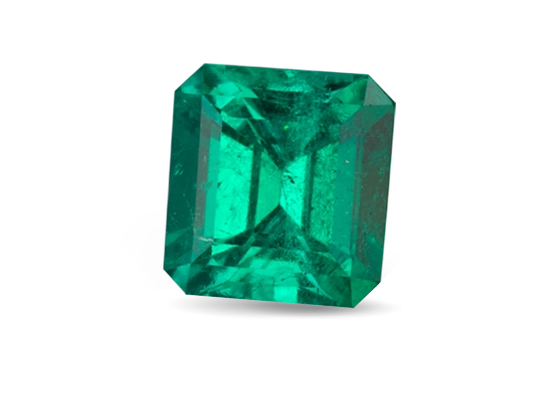
Emerald: the green gemstone to choose with expertise
The emerald is not simply “a green stone”. It is a gemstone that must be read with an expert eye: colour, transparency, inclusions, cut and treatments all interact with one another and determine both its beauty and its suitability for the piece of jewellery one wishes to create.
In my selection work I look at the emerald with particular attention: the green must be intense but readable, the stone must have character, and any presence of inclusions must be evaluated not as an automatic defect, but as part of its visual and structural balance.
What is the emerald
From a gemmological point of view, the emerald is the green to greenish-blue variety of beryl, the same mineral species to which aquamarine also belongs. The distinction between emerald and green beryl is not merely a matter of name: when the green is too light or lacks saturation, many industry professionals prefer to classify the stone as green beryl rather than emerald.
Colour is therefore the first major theme. In a quality emerald, one looks for a vivid, well-distributed green with significant saturation and a tone that is not overly dark. If the stone leans too much towards yellow or too much towards blue, the valuation changes and it may fall outside the realm of the most desirable emerald.
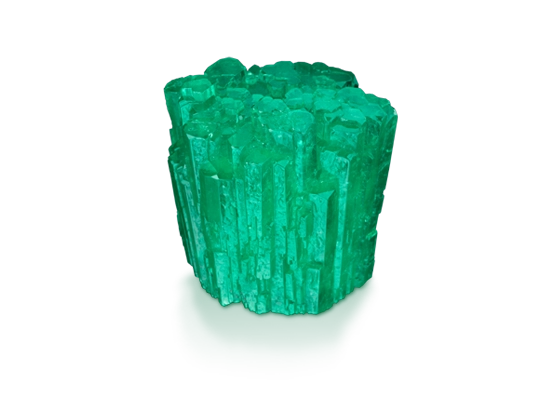
Emerald, May and anniversaries
The emerald is traditionally associated with the month of May. It is also linked to the twentieth and thirty-fifth wedding anniversaries: two occasions where green can become a story of continuity, rebirth, memory and promise.
This is why the emerald is also suitable for a Narrative Jewellerynot just a precious object, but a creation built around a personal story. For an anniversary, an emerald pendant or ring can speak much more intimately than a purely decorative choice.
Origin, deposits and journey of the gemstone
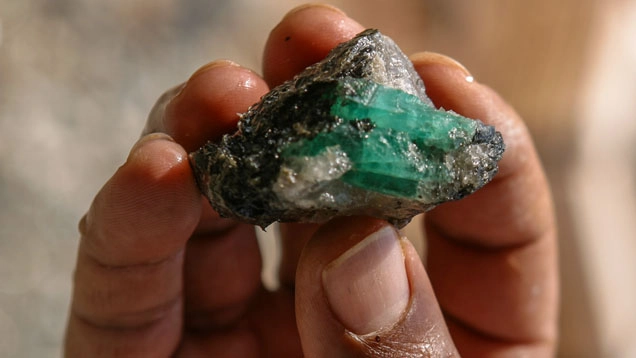
The history of the emerald spans ancient civilisations, historic mines and major collections. The earliest known mines are associated with Egypt; Colombia is one of the most famous areas, and names such as Muzo, Chivor and Coscuez frequently recur in gemmological literature. The emerald is also found in Brazil, Zambia, Pakistan and Afghanistan.
When evaluating a gemstone, origin can be an important factor, but it should never be attributed just by looking at a photograph or listening to a commercial statement. Consistent gemmological documentation is required. For this reason, in a journey of guided gemstone selection, I prefer to distinguish between what is visible and what needs to be verified with analyses and documents.

Colour and visual characteristics
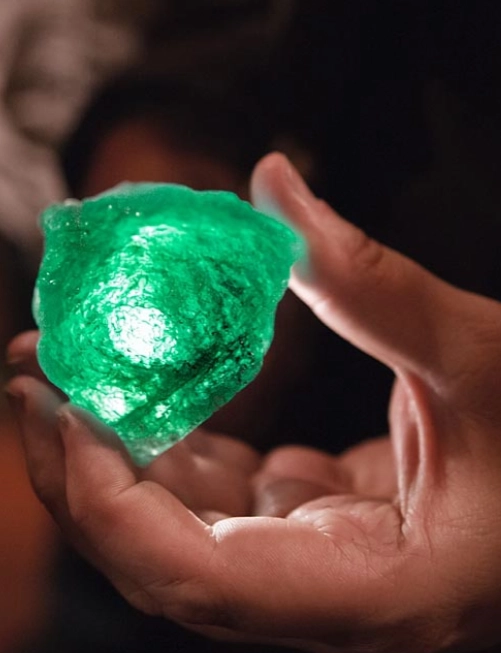
The emerald is loved for its green. When evaluating, hue, saturation, lightness and uniformity are observed: a bluish green or pure green, vivid and not too dark, is generally the most sought-after reference. Transparency remains important, but in the emerald one must read inclusions with a different sensitivity compared to other gems.
Many emeralds show inclusions visible to the naked eye. In the trade these inclusions are often called garden, meaning “garden”, because they can create an internal landscape. An eye-clean emerald is rare and can be of very high value, but the presence of inclusions alone is not enough to make a stone uninteresting: what matters is the overall effect on transparency, beauty and stability.
What is a trapiche emerald
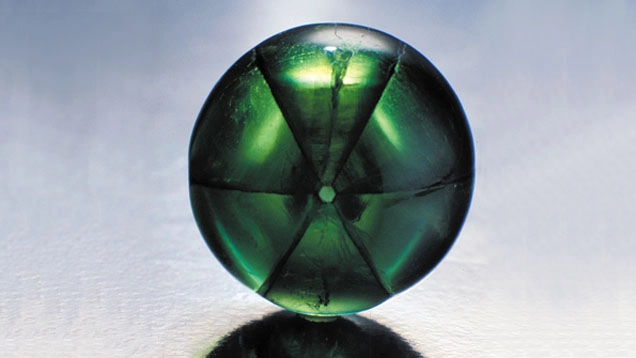
The trapiche emerald is a particularly rare and recognisable formation. During the growth of the crystal, included materials concentrate along the boundaries between the different sectors, creating a radial pattern that can resemble a spoked wheel. The name sugar mill it derives in fact from the toothed wheels traditionally used for processing sugarcane.
In some specimens a central core from which six arms develop is visible; in others, the rays appear to start directly from the centre of the gemstone. The number and arrangement of the arms depend on the crystal symmetry of the mineral: in the emerald, which belongs to the hexagonal system, the typical pattern features six sectors.
The trapiche structure must not be confused with the asterism of so-called star stones. In a star gem, such as certain rubies, sapphires or quartzes, the star is an optical effect produced by the reflection of light on oriented inclusions and can shift when the position of the light or the stone changes. In the trapiche, however, the pattern is a permanent internal structure, generated during the crystal's growth, and remains fixed when observing the gem from different angles.
In Colombian trapiche emeralds, the dark rays may comprise host rock material, carbonaceous substances or organic matter, as well as minerals such as albite, carbonates and pyrite. The precise composition of the inclusions can, however, vary from one specimen to another and must be determined through gemmological analysis, not solely by visual appearance.
Gemmological technical data of the emerald
| Mineral species | Beryl |
|---|---|
| Variety | Emerald, from green to bluish green |
| Chemical formula | Be3Al2Si6O18 |
| Colour | Vibrant green; the most desired colours range from bluish green to pure green with vivid saturation |
| Refractive index | 1.577–1.583 |
| Birefringence | 0.005–0.009 |
| Specific gravity | 2.72 |
| Mohs hardness | 7.5–8 |
| Relevant optical and visual characteristics | Inclusions often visible, garden, possible bluish-green to yellowish-green dichroism; in the trapiche variety the inclusions may form a radial pattern |
| Tenacity and cleavage | For the jewellery it is prudent to consider the fractures and greater vulnerability of the emerald compared to gems such as corundum |
Quality factors: how an emerald is evaluated
Colour
Colour is the centre of the evaluation. An emerald that is too dark loses its life; one that is too light risks being perceived as a green beryl. The best choice is often a balance: intense green, good brightness, vivid saturation and an absence of overly prominent colour zones.
Purity
Clarity in the emerald should be interpreted with realism. Inclusions are frequent and often accepted on the market; they become a problem when they markedly reduce transparency, compromise the beauty of the gem or reach structurally delicate areas.
Cut
The emerald cut also arises from a practical need: the truncated corners can help protect a gemstone with natural fractures. The cutter must take into account the depth of colour, inclusions, relative fragility and final yield. A good cut seeks not just brilliance, but a balance between green, proportions and the safety of the stone.
Carat weight
Cut emeralds exist in very different sizes, from small calibrated stones to important ones. Quality being equal, the price can increase significantly as the weight increases, especially when colour, transparency and cut remain compelling.
Treatments, synthetics and imitations
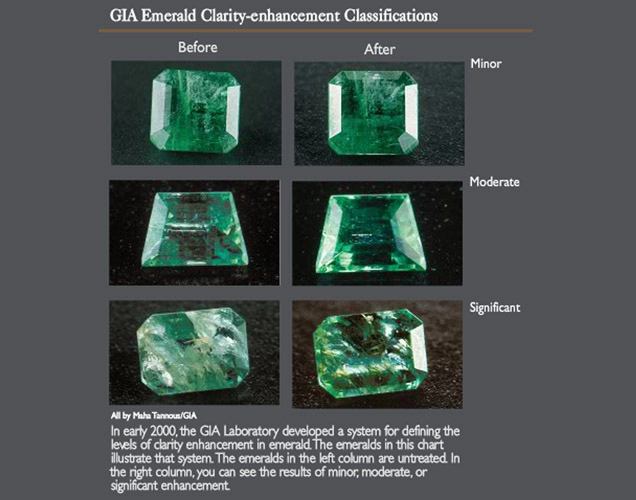
The emerald is often treated to improve colour or apparent clarity. Treatments mentioned in gemmological sources include the dyeing of lighter or fractured materials and the filling of fractures with oils, waxes or artificial resins. The point is not to demonise every treatment, but to understand their nature, stability and impact on value.
In the selection work I always ask for clarity: a minor filling does not have the same commercial weight as a significant intervention. It is important to know whether the stone is natural, synthetic or an imitation, and this distinction should not be based on visual impressions. For an important emerald, documentation and analysis are an integral part of the value.
Emerald care and maintenance
The emerald requires more attention than many other gemstones. Its hardness of 7.5–8 makes it resistant to scratching in many contexts, but fractures and fillings can make it sensitive to heat, knocks, chemicals and pressure changes.
I avoid recommending ultrasound and steam for emerald. The safest cleaning is with lukewarm water, a little mild soap and a soft brush, without leaving the gemstone exposed to heat or harsh detergents. In a ring meant for frequent wear, the setting must protect the stone and allow regular checks of the claws.
Emeralds in bespoke jewellery
In a project of Personalised jewellery, the emerald is at its best when chosen alongside the design of the setting. Not all green stones are suited to the same use: a pendant allows for more dramatic choices; a ring requires more caution regarding inclusions, edges, the position of the claws and the style of daily wear.
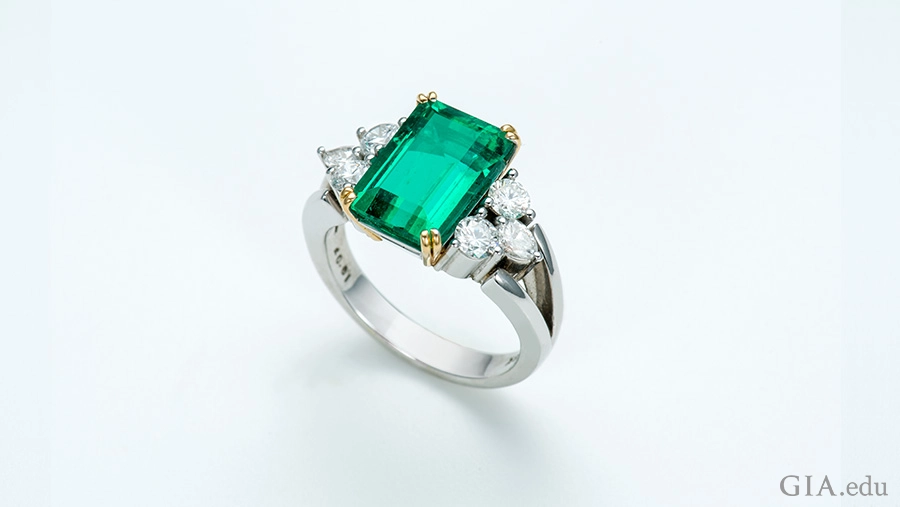
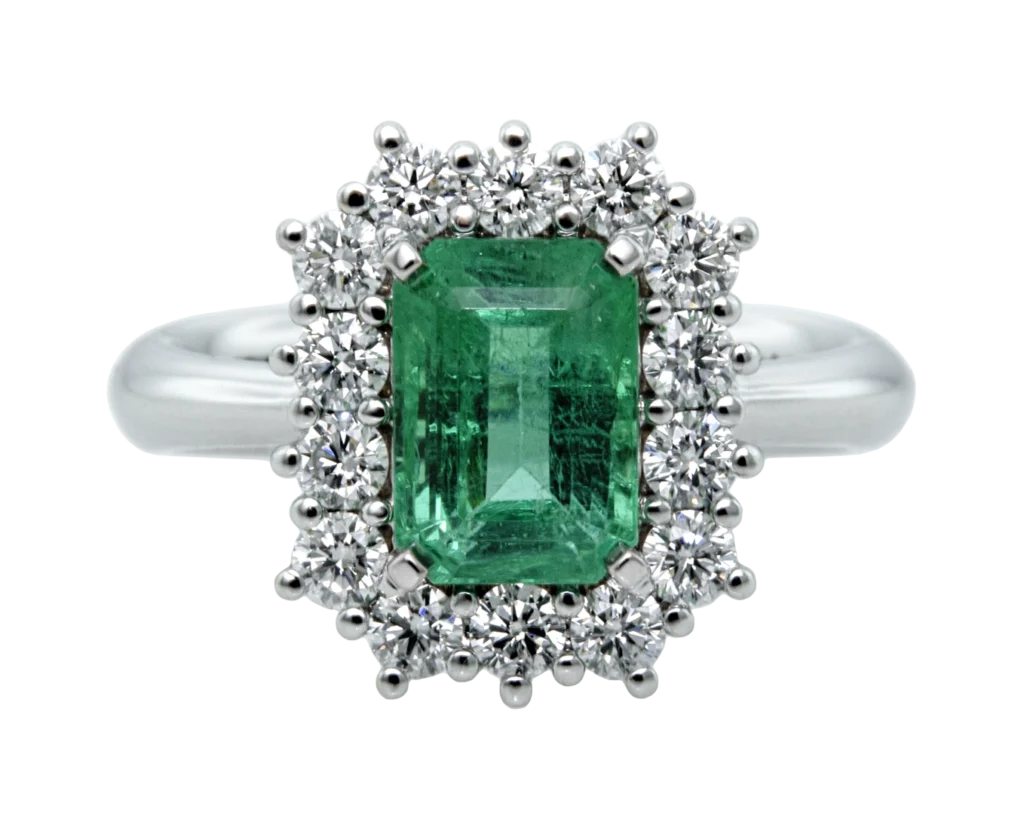
For a coloured gemstone engagement ring, the emerald can be magnificent, but it needs to be designed with protection. The rectangular cut, a well-constructed setting and mindful wear can enhance it without turning it into a fragile or impractical choice.
Common errors when choosing an emerald
Just look at the green
Green seduces, but it is not enough. One must also observe transparency, colour distribution, inclusions, proportions and treatment.
Confusing inclusions with severe defects
Inclusions are frequent in the emerald. The problem arises when they compromise the transparency, stability or overall beauty of the gemstone.
Neglecting treatments
An emerald can be very beautiful and treated. The difference lies in knowing this, documenting it and correctly evaluating the degree of enhancement.
Choose a non-protective frame
The setting must respect the gemstone. Angles, prongs, bezel, ring height and intended use affect the durability of the jewellery.
Frequently asked questions about emerald
Is the emerald a suitable stone for a ring?
Yes, it can be, but it requires careful selection and a protective setting. I don't treat it as an “anything goes” gem: for an everyday ring, I assess inclusions, edges, treatments and the habits of the person who will wear it.
Are inclusions in emeralds always negative?
No. Many emeralds feature visible inclusions. They become penalising when they significantly reduce transparency, disturb the aesthetics or create major points of weakness.
How do you clean an emerald?
Use warm water, mild soap and a soft brush. It is wise to avoid ultrasound, steam, heat and harsh chemicals, especially if the stone has fracture fillings.
Can the emerald be synthetic or imitated?
Yes. For this reason, when dealing with an important gemstone, the evaluation must include gemmological documentation and treatment verification. The trained eye helps, but it does not replace analysis.
What is the best colour for an emerald?
Generally speaking, greens ranging from bluish-green to pure green are sought after, with vivid saturation, a tone that is not too dark and good colour distribution.
A choice to be made at leisure
The emerald rewards those who are not in a hurry. It is a gemstone to be observed in the light, to be compared, to be read in its internal structure and to be designed alongside the piece of jewellery. For this reason, the best choice often stems from a dialogue between desire, gemmological expertise and goldsmithing sensitivity.
To compare the emerald with other gemstones, you can also consult the gem encyclopedia.
Would you like to evaluate an emerald for a bespoke piece of jewellery?
The GIA assumes no responsibility for the content of this article, as the Italian translations have not been checked by the GIA. I am not a GIA associate and the original reference content comes from the site www.gia.edu.