

Amethyst: the purple quartz stone, elegant and surprisingly versatile
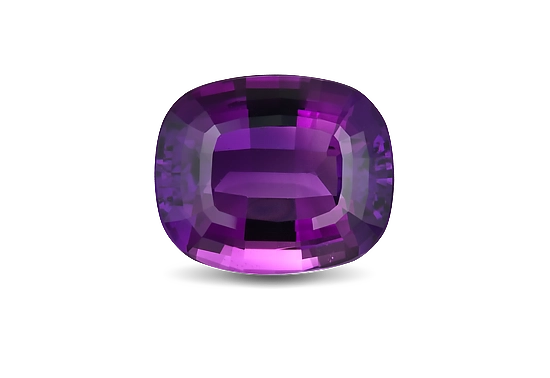
The amethyst is a gemstone that speaks immediately through its colour. It can be understated, almost lilac, or deep and theatrical, with a saturated purple that takes centre stage in the jewel. In my work, I consider it an interesting stone when a client is looking for a coloured gemstone that is recognisable, elegant, but not necessarily ostentatious.
This guide is designed to help you read amethyst with a more confident eye: what it is, which colours are most desired, what treatments might exist, how it should be cared for, and when it makes sense to choose it for a Personalised Jewellery.
What is amethyst
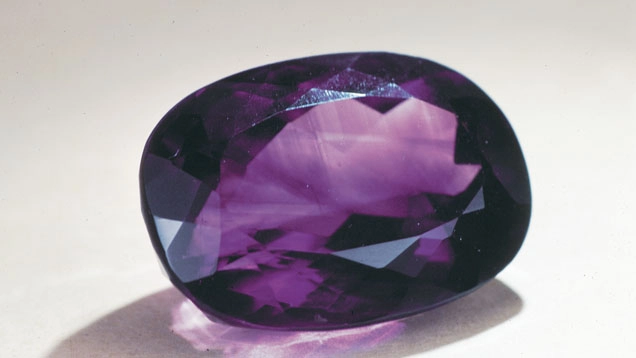
Amethyst is the purple variety of quartz. Its gemmological identity is therefore linked to quartz, but its charm stems from its range of purples: from light lilac to deep purple, with possible cooler, bluish or warmer, reddish undertones.
Compared with other purple gemstones, amethyst is often more accessible and available in generous sizes. This makes it suitable both for everyday jewellery and for more dramatic pieces, provided the setting is thoughtfully designed and the stone is chosen with care.
Months, anniversaries and special occasions
Amethyst is traditionally associated with the month of February. It is also designated as the gemstone for the sixth and seventeenth wedding anniversaries. For this reason, it can work well in a piece of jewellery with personal value: a ring, a pendant or a bracelet designed not only for its colour, but for a specific milestone. According to GIA, amethyst is the traditional birthstone for February and the gemstone associated with the sixth and seventeenth wedding anniversaries.
In historical narrative, the name of amethyst has been linked to the ancient Greek tradition and the theme of lucidity. Today it is correct to read it as cultural and symbolic heritage, not as a promise of effects on the person. In a Narrative Jewellery, this type of reference can become an elegant detail, provided it is handled with restraint.
Geological origin and deposits
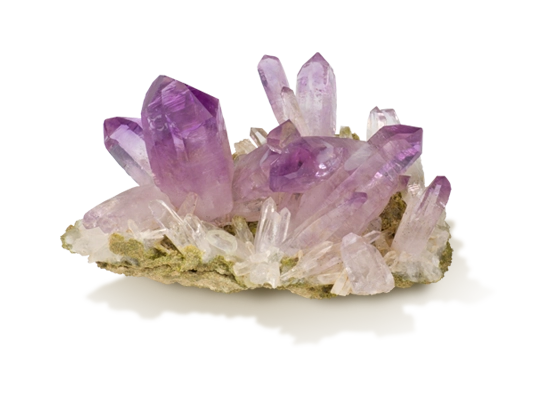
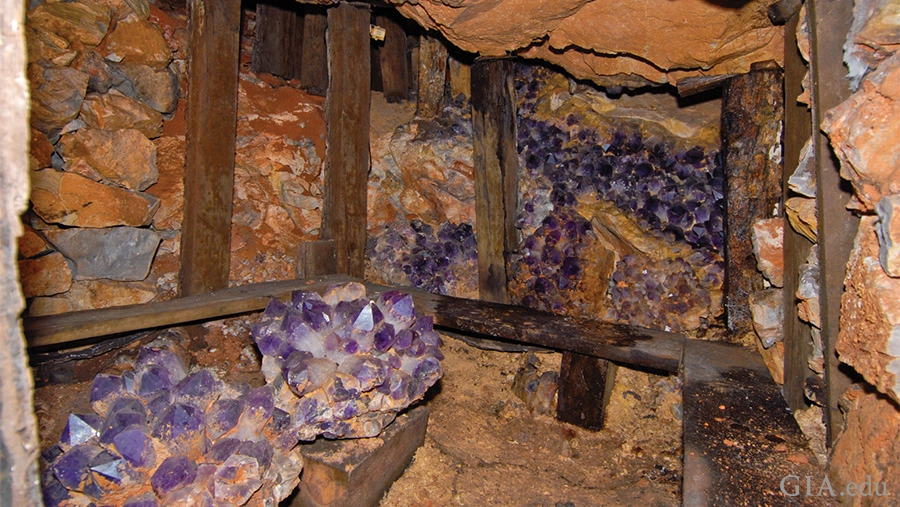
Amethyst can form in cavities and geodes, where the crystals grow on the inner walls of the rock. Some natural specimens clearly show this origin: before becoming a cut gemstone, amethyst is a quartz crystal that has acquired its colour and structure over geological time.
The best-known sources include areas of Brazil and Uruguay, African deposits such as those in Zambia, and sites in Bolivia also associated with the two-coloured purple-and-yellow quartz known as ametrine. However, provenance alone is not enough to determine a stone’s value: colour, cut, transparency and gemmological reports remain decisive factors.
Aside from Brazil, smaller deposits are found in Bolivia (which is also home to ametrine, a bicolour amethyst-citrine variety), Morocco and Canada.
Colour and visual characteristics of amethyst
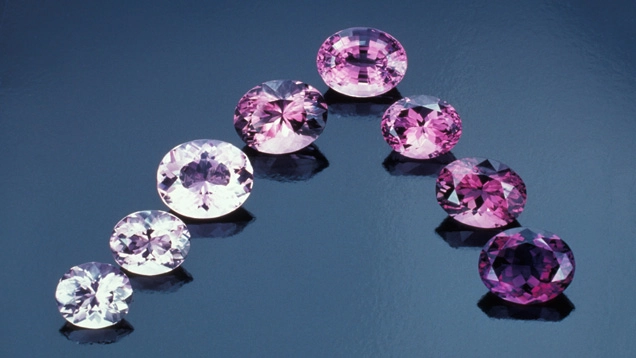
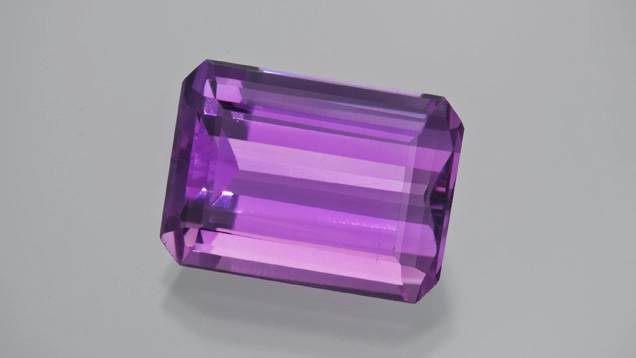
Colour is the first factor to consider. The most highly prized amethysts generally display a rich purple, ranging from deep purple to reddish purple, without any overly prominent patches of colour. A stone that is too dark may lose its brilliance in low light; one that is too light may appear delicate but less striking as the centrepiece of a piece of jewellery.
When I assess an amethyst for a client, I don't just look at “purple” in a generic sense. I observe how the colour moves through the gemstone, whether there are lighter or darker areas, whether the cut illuminates the centre well and whether the stone retains its personality even outside of photographic light.
The most precious colour is an intense, uniform reddish purple, without dark or brownish areas. A shade that is too dark can appear black in poor lighting, while a shade that is too light can look dull.
According to GIA, the finest colour is a purple to reddish-purple, uniform, with no visible colour zoning that breaks the overall harmony.
Gemmological technical data
| Mineral species | Quartz |
| Chemical composition | SiO₂ |
| Colour | Violet, from lilac to deep purple |
| Refractive index | Circa 1544–1553 |
| Birefringence | Approximately 0.009 |
| Specific gravity | Around 2.66 |
| Mohs hardness | 7 |
| Use in jewellery | Suitable for many types of jewellery, with adequate protection in the most exposed rings |
Quality factors: how to recognise a good amethyst
Colour
A good colour must be full without being dull. The ideal purple should not turn black in poorly lit environments and should not show obvious brownish undertones. The colour zones can be natural, but if they are very marked they affect the harmony of the stone.
Transparency and inclusion
Many faceted amethysts available on the market are clear to the naked eye. Small inclusions may be acceptable if the stone has a striking colour or if the cut complements them well. In bespoke jewellery, the right question is not simply “Is it perfect?”, but “Is the overall effect beautiful, stable and consistent with the design?”.
Cut
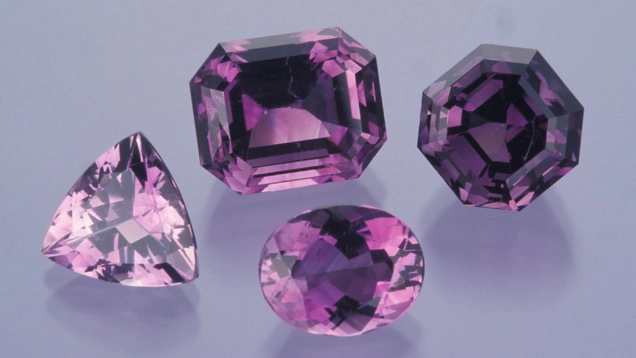
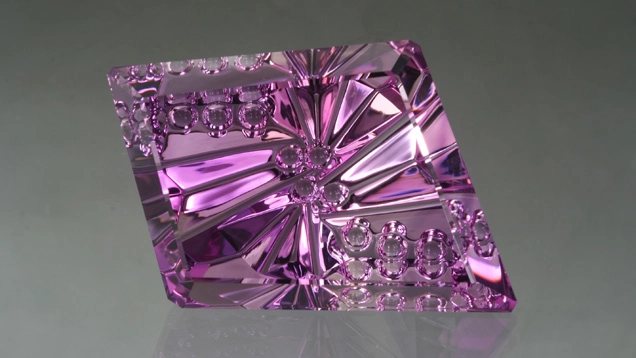
Amethyst lends itself to oval, round, pear, rectangular, trillion and cushion cuts, as well as fancy cuts. The cut must distribute the colour evenly: a gem that is too deep may appear dark, whilst one that is too flat may lack body.
Carat weight
Amethyst is often available in large sizes too. This is a creative advantage: it allows for the design of jewellery with a generous visual presence without necessarily entering into the price dynamics of rarer gemstones. However, it remains essential not to choose based on size alone.
Practical buying advice
Before buying an amethyst, I advise observing it in multiple lighting conditions. Photography can enhance the purple a lot, but the stone must also convince you in person: in natural light, in warm light, and in light shade.
Always ask whether the gemstone is natural or synthetic, whether it has been treated, and whether there is any relevant documentation. For a significant piece of jewellery, particularly if it is bespoke, it makes sense to ensure that the choice of stone forms part of a clear process of Method and Guarantees: not to complicate the purchase, but to make it more reassuring.
Treatments, synthetics and imitations
GIA includes amethyst among the gemstones for which there are processes capable of modifying colour, apparent clarity or durability, referring to the general section dedicated to gemmological treatments.
Heat treatment can be used to modify the appearance of some amethysts, for example by lightening a colour that is too dark. Synthetic amethysts also exist, with chemical and physical properties substantially similar to their natural counterpart, and in certain cases distinguishing them requires advanced gemmological analysis.
The GIA classification distinguishes between synthetic gemstones, which have chemical, physical and optical properties that are essentially similar to those of natural gemstones, and imitations, which merely replicate their appearance, whether natural or artificial.
Imitations are another issue: natural or artificial materials can be used to imitate the purple colour of amethyst. For this reason, transparency in commercial description is important. A synthetic stone is not “wrong” in absolute terms, but it must be declared; an untreated natural stone, when requested, must be consistent with what is promised.
Heating can lighten an excessively dark purple or turn amethyst into citrine, the yellow variety of quartz, which is why it is important that the gemstone's nature and treatments are correctly declared.
Ametrine and bicolor quartz
Dual-coloured purple and yellow quartz is linked to the theme of’ametrine, in which areas of amethyst and citrine they coexist in the same gemstone. It is a fascinating material, but it must be presented correctly: it is not a simple purple amethyst, but rather a bi-coloured quartz with its own distinct identity.

Care and maintenance of amethyst
With a hardness of 7 on the Mohs scale and good toughness, amethyst is suitable for many pieces of jewellery, including rings, provided the limitations of quartz are respected. It can scratch if it comes into contact with harder gemstones such as sapphires, rubies and diamonds; for this reason, it should be stored separately.
For routine cleaning, lukewarm water, mild soap and a soft brush are preferable. I would avoid steam. Heat and thermal shock also deserve caution, as they can affect the stability of the stone; prolonged exposure to intense light can, in some cases, encourage fading of the colour.
The care instructions are in line with the general GIA recommendations for quartz: gentle cleaning, and care with knocks, heat and thermal shock.
Amethyst in bespoke jewellery
Amethyst works well when the design highlights colour rather than treating it merely as decoration. In yellow gold, the purple becomes warm and regal; in white gold or platinum, it appears fresher and more contemporary; in rose gold, it can take on a romantic, soft, highly personal tone.
For a coloured gemstone engagement ring, amethyst can be a poetic choice, but it needs to be protected with a suitable setting and with correct expectations regarding daily wear. For narrative pendants, earrings and bracelets, on the other hand, they offer great freedom: they can be the central focus, chromatic details or textural fragments in more artisanal compositions.
Common Errors to Avoid
Choose only the darkest purple
An intense violet is desirable only if it remains vibrant. If the stone closes up and appears almost black, the colour loses readability.
Ignore the colour zones
Colour zoning can be natural, but it needs to be observed. In some stones it adds character; in others it disturbs the balance of the cut.
Buying solely on carats
A large amethyst is not automatically better. Proportion, cut, transparency and colour matter more than the stated carat weight.
Do not ask for information on natural, synthetic and treatments
Commercial clarity is part of quality. A gemstone must be described for what it is, without ambiguity.
Handle it like it's an indestructible gemstone
Amethyst is durable for many uses, but it is not a diamond. A good setting and proper maintenance make all the difference over time.
Amethyst FAQ
Is amethyst a gemstone?
It is a highly prized and historically important gemstone, though today it is generally more accessible than gemstones such as ruby, sapphire or emerald. Value depends on colour, cut, transparency, size, commercial origin and gemmological reports.
Is amethyst suitable for a ring?
Yes, it can be used in rings, but with care. A hardness of 7 makes it suitable for many pieces of jewellery; for more exposed rings, it is better to prefer protective settings and mindful wear habits.
What is the best colour of amethyst?
Saturated purples, ranging from purple to reddish-purple, are generally very popular, without obvious zoning and without a too dark effect in low light.
Does synthetic amethyst exist?
Yes. Synthetic amethyst exists and can be difficult to distinguish from natural amethyst without proper gemmological testing. The decisive factor is that it is correctly declared.
How do you clean amethyst?
For routine cleaning, warm water, mild soap and a soft brush are suitable. It is wise to avoid steam, intense heat and sudden temperature changes.
Does amethyst have therapeutic properties?
In jewellery, I consider the amethyst for its colour, history, gemmological quality and symbolic value. Historical traditions should not be confused with proven therapeutic effects.
Choosing an amethyst with a goldsmith's eye
A good amethyst is not just a purple stone. It is a balance of colour, light, cut and personal narrative. It can become a discreet piece of jewellery or a bold statement, a February gift, an anniversary or a very precise colour choice.
If you are considering an amethyst for a bespoke project, the point is not to buy the biggest gemstone, but to choose the one that best converses with the hand, with the metal and with the story you want to wear. You can continue to find out more in the’Encyclopaedia of the gems or discuss your project with you directly.
Do you want to find out if amethyst is suitable for your piece of jewellery?
The initial meeting serves to clarify direction, timing, and feasibility. It does not require an immediate decision.
The GIA assumes no responsibility for the content of this article, as the Italian translations have not been checked by the GIA. I am not a GIA associate and the original reference content comes from the site www.gia.edu.