
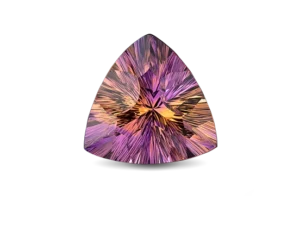
Ametrine: guide to the bicolour gemstone between amethyst and citrine
Ametrine is a gemstone that seems made for those who do not want to choose between two colours. In the same crystal, the purple of amethyst and the yellow-orange of citrine coexist, with sharper or softer transitions depending on the cut. It is a luminous stone, but far from ordinary: its value lies not only in its transparency, but in the way the two chromatic souls meet.
In my work, I consider it a gem to be evaluated with a designer's eye. A good ametrine must be beautiful on its own, but above all it must have a colour distribution suited to the piece of jewellery that will be created: a ring, a pendant, earrings or a bespoke narrative creation.

What is ametrine
Ametrine is a transparent bicoloured quartz. The name comes from the combination of amethyst and citrine: when both colours appear in the same gemstone, the material is called ametrine or amethyst-citrine. It is therefore not a half-and-half gemstone in the commercial sense, but a distinct manifestation of quartz, in which the colour becomes part of the crystal's visual structure.
Its personality changes greatly depending on the arrangement of the colours. Some ametrines show an almost geometric boundary between purple and yellow; others blend the two zones with more complex internal reflections. For this reason, the choice of cut is decisive: it can make the two-tone effect clear and legible, or transform it into a softer, more dramatic play of light.
Month, anniversaries and symbolic value
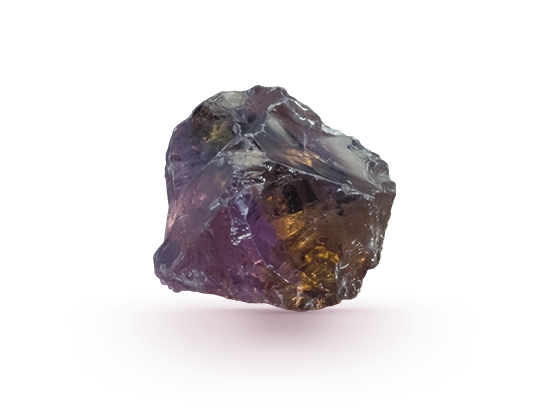
GIA does not feature ametrine as a traditional standalone birthstone. Its symbolic power, however, is clear: it unites two colours and two emotional families, the more introspective purple of amethyst and the sunnier yellow of citrine. For this reason, it can work well in a piece of jewellery linked to a transition, a dual identity, a couple or a personal story.
When meaning matters more than convention, ametrine can become a sophisticated choice for narrative jewellerynot a stone chosen just for fashion, but a gem capable of telling of balance, contrast and transformation.
Origin and deposits
GIA indicates a single commercial source for natural ametrine: the Anahi mine in Bolivia, described as the only commercial source of this two-colour material. This information is important, but it must be used correctly. It does not mean that every single stone can be declared as Bolivian without documentation; it means that, in the gemmological market, commercial natural ametrine is strictly linked to that source.
In a sales sheet or a bespoke project, the origin of an individual specimen must be supported by documentation. Two-tone colour alone is not enough to attribute a provenance with certainty.
Colour and visual characteristics
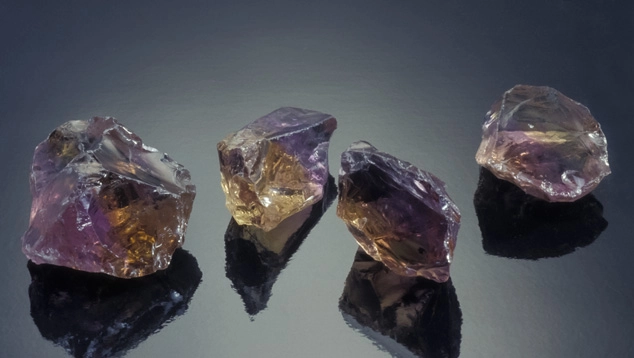
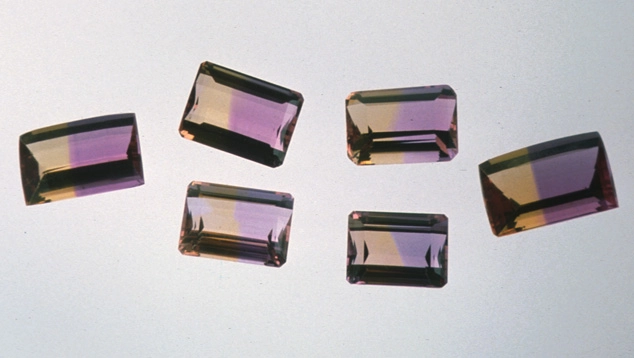
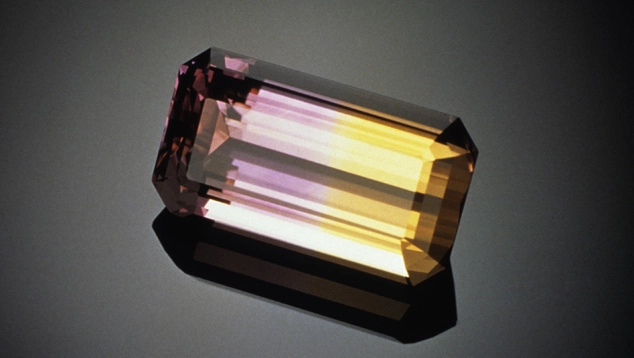
Colour is the heart of ametrine. The purple zones recall amethyst; the yellow, yellow-orange or golden ones recall citrine. The most interesting ametrines display a pleasant and distinct contrast between the two areas, without one cancelling out the other.
The dividing line can be sharp, central and almost architectural, or more subtle. In either case, what matters is balance: a well-chosen gemstone should not look accidental, but intentional. This is why I prefer to observe ametrine in both natural and controlled light before deciding how to set it.
| mineral species | Quartz. |
|---|---|
| Gemmological name | Ametrine, also known as amethyst-citrine when amethyst and citrine appear in the same gemstone. |
| Chemical composition | SiO₂. |
| Colour | Orange/yellow and purple bicolour, with variable distribution between the two areas. |
| Refractive index | 1.544–1.553. |
| Specific gravity | 2.66 (+0.03/-0.02). |
| Mohs hardness | 7. |
| Main visual characteristic | Two-tone purple and yellow-orange colour zoning, enhanced by the cut. |
Quality factors: what to look for before buying
Colour
A fine ametrine must display two recognisable colours. The contrast between purple and yellow-orange is essential: if one zone is too weak, the gemstone loses part of its character. Quality ametrines show good contrast between orange and purple.
Distribution of the black-and-white colour scheme
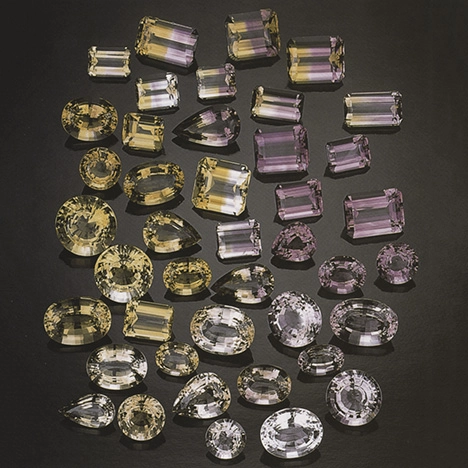
Many dealers appreciate a balanced distribution, often almost fifty-fifty, with a clear boundary in the centre of the cut gemstone. It is not an absolute aesthetic rule, but it is a useful criterion for understanding whether the cut has truly enhanced the two-tone nature of the material.
Clarity
Faceted ametrine generally doesn't show inclusions visible to the naked eye. When evaluating a stone, I therefore look for clean transparency, without fractures or elements that disrupt the reading of the colour.
Cut
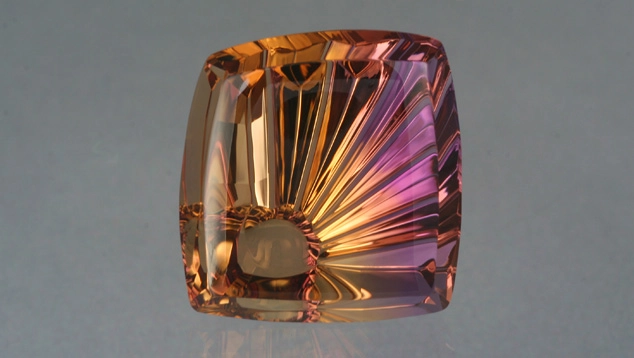
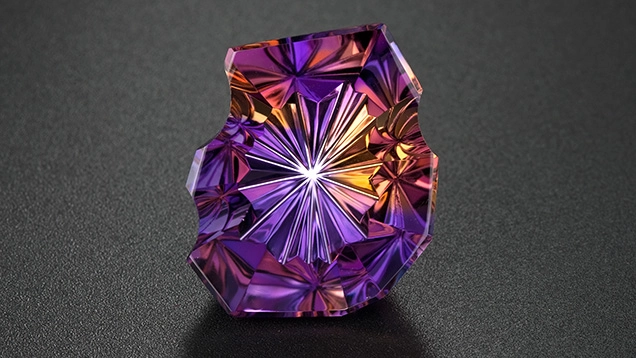
The rectangular step cut is very suitable because it neatly shows the colour separation. Fancy, concave or mixed cuts can instead blend the colours and create more dramatic reflections. The choice depends on the type of jewellery: classic, geometric, contemporary or more artistic.
Creative cutting and colour interpretation
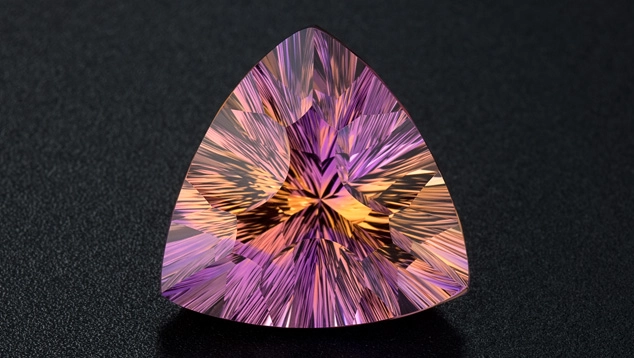
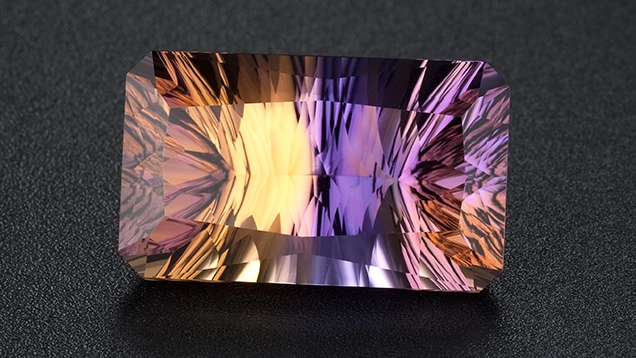
Ametrine is a gemstone beloved by cutters because every crystal offers a different colour map. A cut can emphasise the division between the two areas, or use internal reflections to blend them. Here the cutter is not just working on brilliance: they are working on the narrative of the colour.
For a Personalised jewellery with coloured gemstone, this aspect is invaluable. Two ametrine stones with a similar weight can yield completely different results: one more graphic and orderly, the other more dynamic and luminous.

Jeweller's buying advice
Before choosing an ametrine, I would look at three aspects: colour balance, cut quality and the intended use of the piece of jewellery. A gemstone with a sharp colour boundary can be ideal for a geometric ring; one with more blended colours may work better in a pendant or a more freely designed creation.
I would also always ask for information regarding weight, any documentation and declared provenance. If the piece of jewellery is for an important occasion, it is useful to establish a clear path from the very beginning of guided gemstone selection, so as to avoid vague descriptions or unverifiable promises.
Treatments, synthetics and imitations
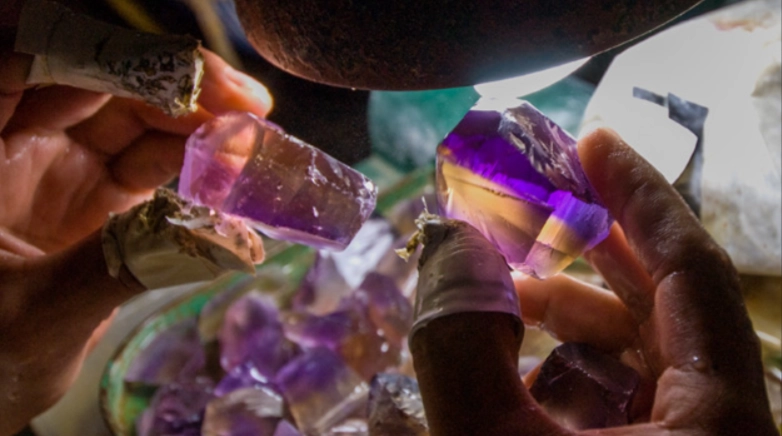
The GIA devotes the “TREATMENTS”, “SYNTHETICS” and “IMITATIONS” sections to ametrine, pointing out that there are processes to modify colour, apparent clarity or durability, synthetic counterparts and materials that imitate the gem's appearance. With ametrine, it is important to distinguish what can be seen from what can be declared. The purple and yellow bicolour is not enough, on its own, to affirm origin, naturalness or the absence of treatment. The GIA generally notes that gems may undergo treatments, have synthetic counterparts or be imitated; for this reason, any commercial information must be supported by consistent documentation.
In GIA terminology, synthetic gemstones have chemical, physical and optical properties that are substantially similar to natural gemstones but are grown in laboratory conditions, whereas imitations – whether natural or artificial – merely replicate their appearance without sharing the same gemmological identity.
In the case of ametrine, there is also gemmological research dedicated to its natural origin and its separation from synthetic materials. For the retail customer, the practical point is simple: when dealing with a significant gemstone, one must not stop at the photograph. A cautious description is needed and, when appropriate, gemmological testing.
Care and maintenance
With a Mohs hardness of 7, ametrine is suitable for use in jewellery, but it is not invulnerable. Dust and sand are largely composed of quartz: precisely for this reason, a quartz gemstone can be scratched or damaged if handled without care.
I recommend simple cleaning with warm water, mild soap and a soft cloth, avoiding knocks, thermal shock and contact with harsh substances. For rings and frequently worn jewellery, a periodic check of the setting is useful.
These guidelines are in line with the general GIA recommendations for quartz gemstones: gentle cleaning, and care regarding impacts, abrasions and thermal shock.
Ametrine in bespoke jewellery
Ametrine can be very interesting in pendants, earrings and protected rings. The hardness of 7 makes it more practical than many delicate gemstones, but the cut and edges still need to be protected with a well-thought-out setting. For a Bespoke Engagement Ring, I would only suggest it when the client really wants a two-tone gemstone and accepts a less traditional choice.
Its strong point is its personality. Where a single hue can feel predictable, ametrine brings movement: two colours, two energies, a single stone. It is perfect when the piece of jewellery needs to have a visible yet not excessive character.
Common Errors to Avoid
Choose only the brightest colour
An intense colour is not enough. In ametrine, the relationship between the two zones matters: contrast, balance and legibility are more important than a single showy tone.
Confusing creative cutting with absolute quality
A fancy cut can be spectacular, but it must serve the gem. If it muddies the colour or masks a weak distribution, it is not automatically the best choice.
Declare origin without a document
GIA indicates the Anahi mine as the commercial source of natural ametrine, but the provenance of the individual specimen must be documented. It cannot be deduced from the colour.
Treating ametrine as a carefree gemstone“
A hardness of 7 is good, but the piece of jewellery must still be protected from impacts, abrasions and aggressive maintenance.
Frequently asked questions about ametrine
What is ametrine?
It is bicoloured transparent quartz in which the colours of amethyst and citrine appear together: purple and yellow-orange in the same gemstone.
Is ametrine rare?
GIA indicates a single commercial source for natural ametrine, the Anahi mine in Bolivia. This makes it important to carefully evaluate the documentation and quality of the individual specimen.
What is the best colour of ametrine?
There is not just one best colour. Generally, you look for a nice contrast between purple and yellow-orange, with a harmonious and readable distribution.
Is ametrine suitable for a ring?
Yes, it can be, thanks to its Mohs hardness of 7. For everyday wear, however, a protective setting, care with knocks and correct maintenance are needed.
Is an octagon or a fancy cut better?
The stepped octagon shows the two-colour separation very well. Fancy cuts can create more artistic effects. The choice depends on the jewellery design.
How do you clean ametrine?
With lukewarm water, mild soap and a soft cloth. It is best to avoid harsh products and periodically check the mounting if the piece of jewellery is worn often.
When to choose ametrine
I would choose ametrine when the piece of jewellery needs to express duality, balance or colour and light. It is an elegant yet unusual gemstone, suitable for those who love colour and want something more personal than a single-coloured stone.
To compare it with other purple, yellow or bi-colour gemstones, it may be useful to continue in the section Gemstone Encyclopaedia. A good choice always stems from the meeting between gemstone, design, real-life use and the story of the person who will wear it.
Do you want to figure out if ametrine is suitable for your jewellery?
The initial meeting serves to clarify direction, timing, and feasibility. It does not require an immediate decision.
The GIA assumes no responsibility for the content of this article, as the Italian translations have not been checked by the GIA. I am not a GIA associate and the original reference content comes from the site www.gia.edu.