
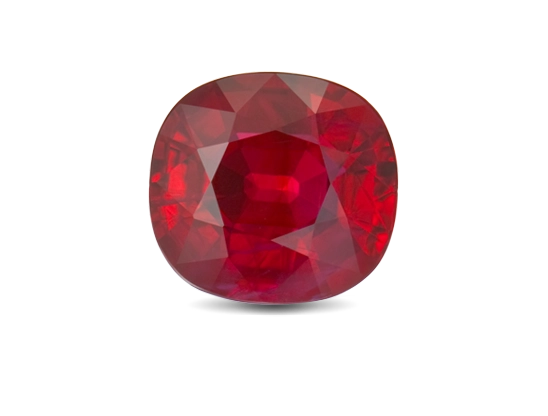
Ruby: the red gemstone of corundum
The ruby is a gemstone that never makes a discreet entrance. Its red evokes energy, desire, authority and memory: for this reason, when a client asks me for an important stone for a ring, an anniversary gift or a narrative piece of jewellery, the ruby is often one of the first gems to be carefully considered.
From a gemmological point of view, the ruby is the red variety of corundum, the same mineral species to which the sapphire belongs. The difference is not merely poetic: it arises from the presence of chromium, the element that gives the ruby its red colour and which, in certain specimens, can contribute to a fluorescence capable of intensifying the perception of the colour.
This guide is designed for those who want to choose a ruby with discernment: not just “beautiful” at first glance, but also consistent with the jewellery design, budget, intended use and necessary documentation.
What is the ruby
The ruby is red corundum. In its pure form, corundum is colourless; when trace elements enter its structure, the colour changes. In the case of the ruby, the main actor is chromium, which is responsible for a chromatic range running from red with orange undertones to slightly purplish red.
For a correct choice, it is important to distinguish the ruby from the pink sapphire. Separation is not always straightforward, because the boundary between red and rosa can be interpreted differently in gemological markets and cultures. In evaluation, however, red must remain the dominant tone for the gemstone to be considered a ruby.
Geological origin and deposits
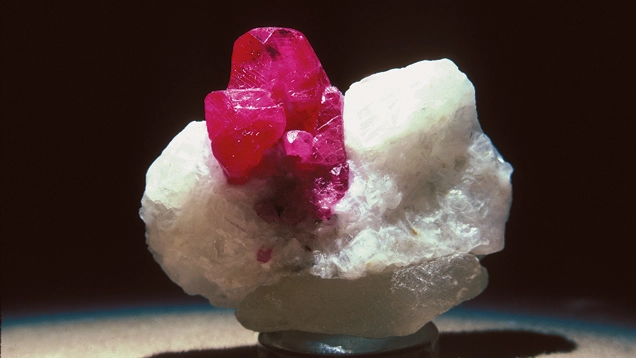
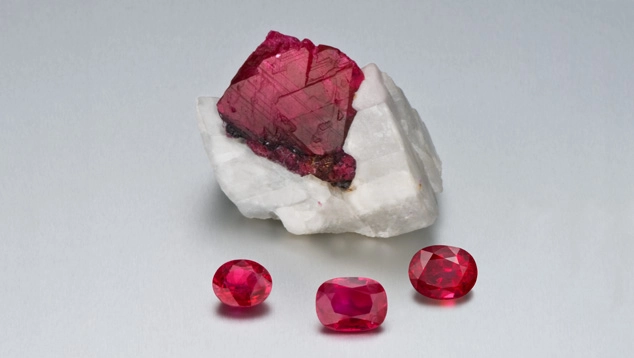
The most famous rubies in history often come from marble-related geological contexts, such as Myanmar, Himalayan areas and northern Vietnam. Marble is poor in iron: this condition can favour a brighter red and a more obvious red fluorescence.
In other cases, rubies are found in basaltic rocks. Here the iron content can be higher and can make the colour darker or less vivid, partly masking the red fluorescence. This does not mean that one origin is automatically superior to another: each deposit produces different qualities, and every stone must be judged individually.
Historically, important areas for ruby include Myanmar, Vietnam, Thailand and Cambodia; in the modern market, Mozambique, Afghanistan, Tajikistan, Pakistan, Sri Lanka, Kenya, Tanzania and Madagascar are also of great significance. When selecting stones, origin can affect their appeal and value, but it never replaces the analysis of colour, clarity, cut, treatment and documentation.


Ruby, birth month and anniversaries
The ruby is traditionally associated with the month of July and is also linked to the 15th and 40th wedding anniversaries. It is a gemstone that works well when a piece of jewellery needs to tell the story of a promise, an anniversary or a strong personal choice.
In my work, the ruby is particularly suited to narrative jewellery, because red is never neutral: it can speak of passion, family, courage, continuity or rebirth, without needing to overload the design of the jewellery.
Colour and visual characteristics
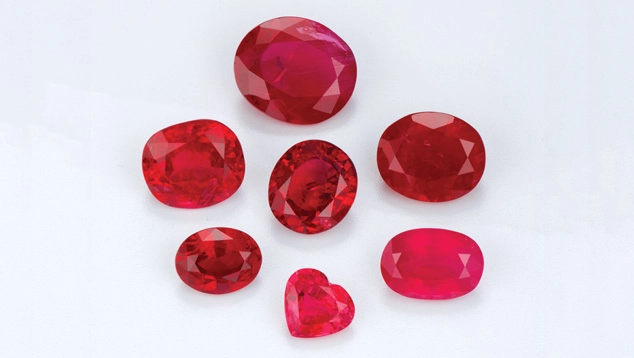
Colour is the primary major quality factor of the ruby. The most desired gemstones display a vivid, pure or slightly purplish red, with intense saturation and a balanced tone: neither too dark, because it would lose brilliance, nor too light, because it might approach the perception of pink sapphire.
Lighting is decisive. A ruby can change colour between natural light, warm light and display cabinet lighting. For this reason, I never advise choosing an important gemstone by looking at it in just one environment. A good selection should be observed under multiple conditions, possibly comparing several stones side by side.
Gemmological technical data for the ruby
| Property | Key data |
|---|---|
| Mineral species | Corundum |
| gemological variety | Ruby, that is red corundum |
| Chemical composition | Al2O3 |
| Main chromophore element | Chromium |
| Colour | Red, with possible orange or purplish shades |
| Refractive index | 1.762–1.770 |
| Birefringence | 0.008–0.010 |
| Specific gravity | 4.00, approximately ±0.05 |
| Mohs hardness | 9 |
| Tenacity | Excellent, except for issues related to fractures or treatments |
| Cleavage | absent |
| Possible optical phenomena | Red fluorescence; asterism in cabochon-cut rubies with oriented inclusions |
| Anniversaries | July stone; 15th and 40th anniversary |
Quality factors: what I look at before proposing a ruby
Colour
Colour weighs more than any other factor. A ruby with bright, luminous and well-distributed red can be more desirable than a larger but dull stone. Orange or excessively purplish undertones, if dominant, can reduce commercial interest.
Clarity and inclusions
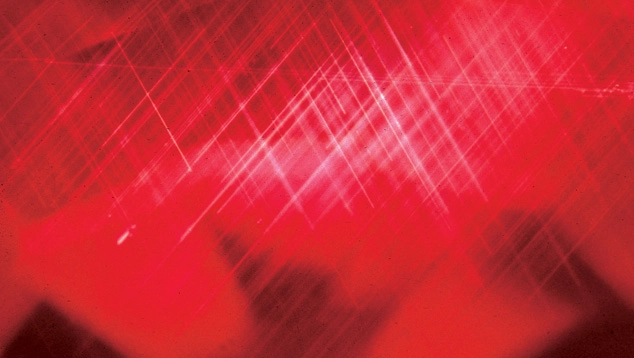
In the ruby, inclusions are frequent; a stone completely free of visible inclusions is rare and must be evaluated with great caution. Inclusions become a problem when they reduce transparency, brilliance or durability, especially if they reach the surface.
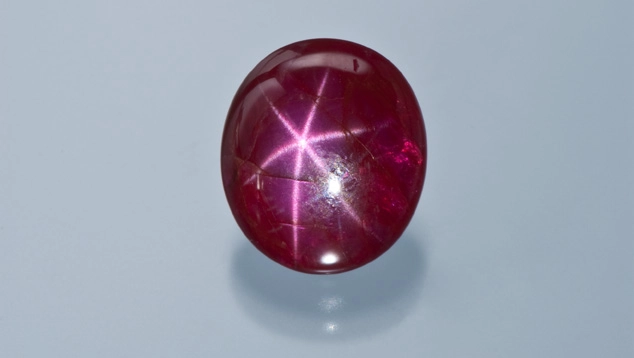
Needle-like rutile inclusions can create so-called “silk”. In some cases they soften the light and make the colour more uniform; if correctly oriented, they can generate asterism in cabochons.
Cut
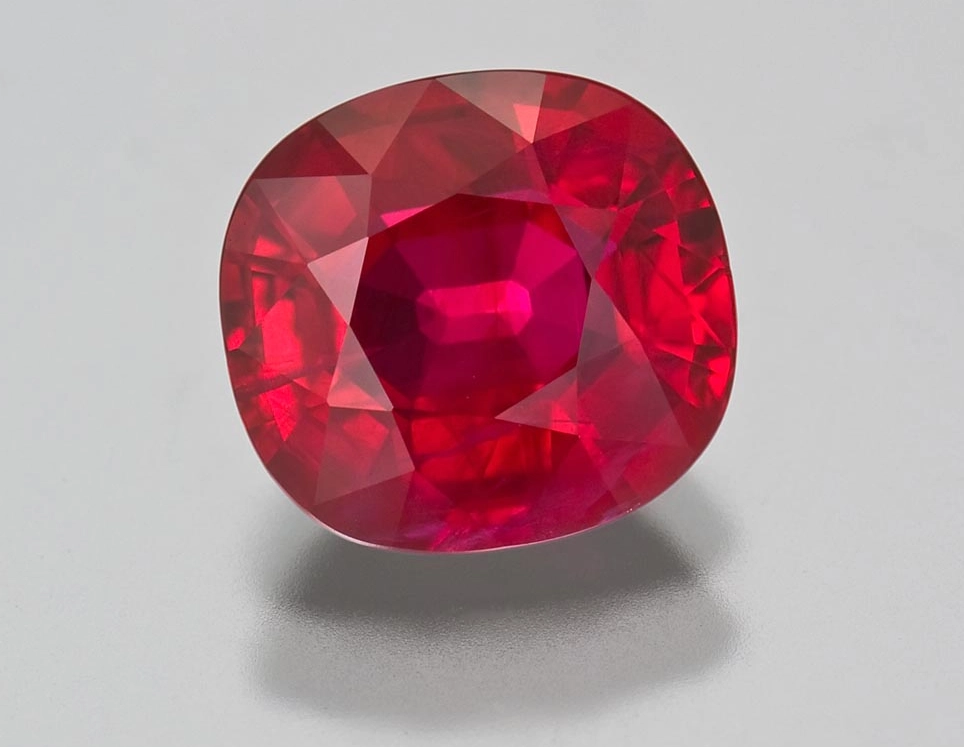
Rubies are often cut into oval and cushion shapes, with a brilliant-cut crown and a step-cut pavilion. The cut must respect the colour, preserve weight where it makes sense, but without excessively sacrificing brilliance. A stone that is too shallow can present a “window”, which is a transparent and dull central area.
Carat weight
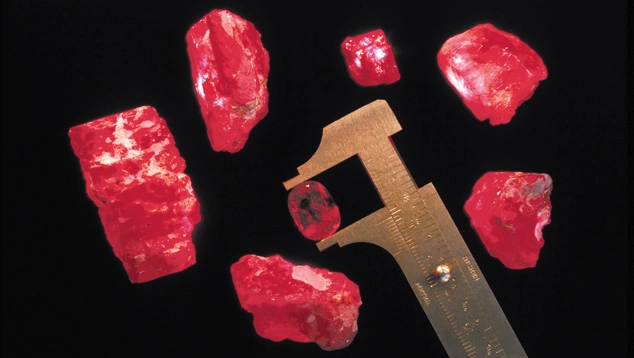
In fine-quality rubies, weight has a major impact on the price. Exceeding one carat with good colour, good transparency and solid documentation is already significant; as the size increases, the value per carat can rise markedly.
Treatments, synthetics and imitations
The most common treatment for ruby is heating, which is used to improve colour and overall appearance. The market widely accepts this when it is disclosed and stable under normal conditions of use. The situation is different for materials involving lattice diffusion, dyeing or the filling of fractures and cavities with glass: these treatments can significantly affect the value and durability of the gemstone.
Before purchasing, it is always correct to ask, in writing, if the stone is treated and by what method. For an important ruby, I recommend independent gemmological documentation: it can indicate whether the stone is natural or lab-grown, whether it shows evidence of treatment and, when possible and requested, an opinion on its geographic origin.
There are lab-grown rubies, with chemical, physical and optical properties substantially corresponding to the natural material, but formed by man. There are also imitations, made with natural or artificial materials used to simulate the appearance of the ruby. Along the path Method and Guarantees, the distinction between natural, treated, cultivated and imitation is an essential part of the choice.
Practical buying advice
When selecting a ruby, I start with four questions: what colour the client wants, what use the piece of jewellery will have, what documentation accompanies the gemstone, and what treatment has been detected or declared.
I do not advise buying a ruby just because it is presented with a famous origin. A historical locality can add value if documented and if the stone has real quality, but it does not automatically make a mediocre gemstone beautiful. Similarly, trade terms like “pigeon's blood” must be interpreted with caution: they evoke a colour category, but they do not replace direct observation and documentation.
For a Bespoke Engagement Ring Regarding the ruby, I am looking for a stone with a good balance of colour, brilliance, inclusions and durability. The ruby is suitable for everyday wear, but the setting must protect the gem, especially if it has fractures, significant inclusions or delicate treatments.
Care and maintenance
The ruby is a very durable gemstone: a hardness of 9, excellent toughness and the absence of cleavage make it suitable for many frequently worn pieces of jewellery. However, durability does not mean invulnerability. A hard knock, a worn setting or an unstable treatment can cause problems.
The safest cleaning method remains warm water, mild soap and a soft toothbrush. Ultrasonic cleaners and steam are generally suitable for untreated, heated or stable lattice-diffusion-treated rubies, but must be avoided for glass-filled, cavity/fracture-filled or dyed rubies: in these cases a damp cloth and professional inspection are preferable.
The ruby in bespoke jewellery
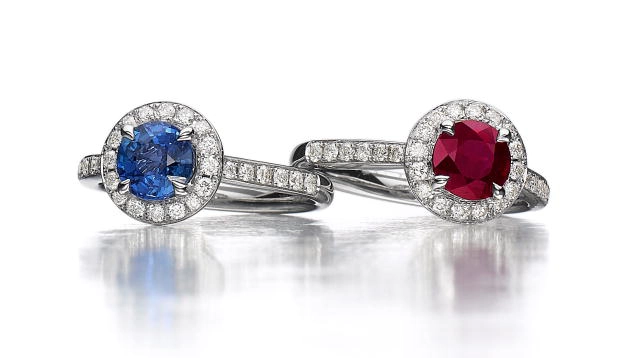
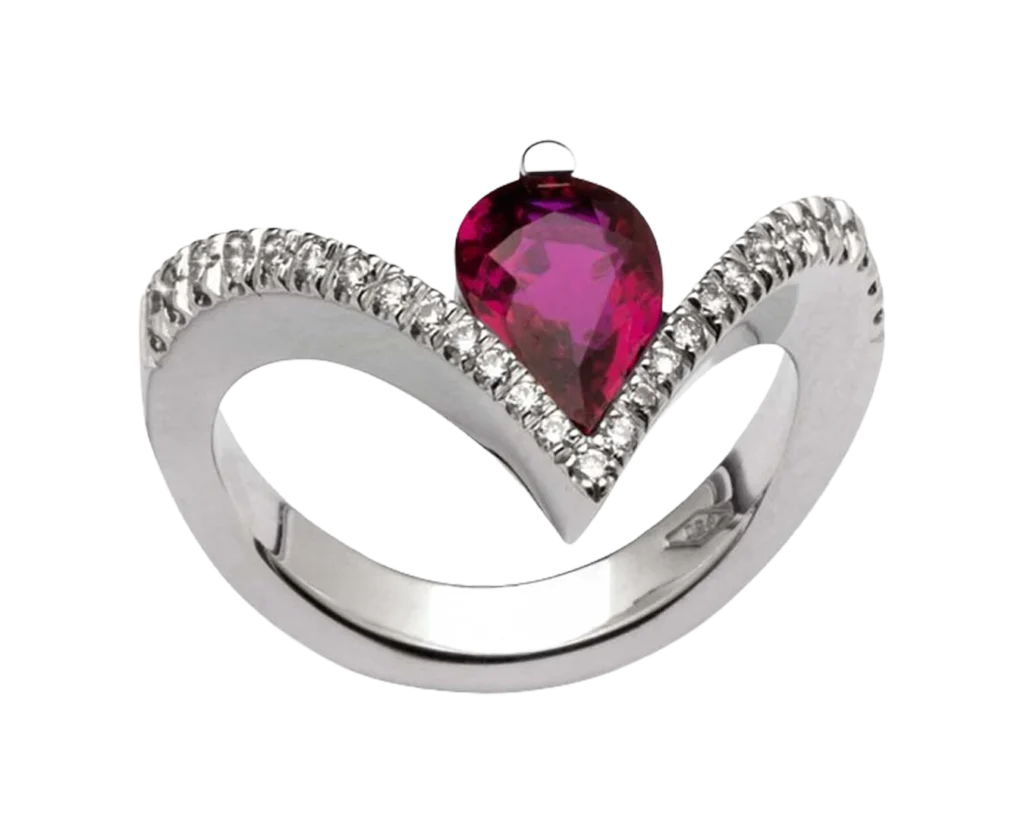
The ruby works very well in rings, pendants, bracelets and earrings. In a bespoke design, however, I never choose the stone separately from the design: the red of the ruby engages in a dialogue with the metal, with the diamonds, with the proportions and with the light that the piece of jewellery will receive when it is worn.
In a ring, the ruby can become the central stone with side diamonds or a bright halo. In a bracelet, it can build rhythm and chromatic presence. In the Personalised jewellery, it is a strong choice when the client wants a recognisable, elegant and non-neutral gemstone.
Anyone wishing to compare the ruby with other red stones or alternative coloured gems can continue in the section Gemstone Encyclopaedia.
Common Errors to Avoid
Buy only the name of the origin
Myanmar, Mogok or other famous origins can have great charm, but the final quality depends on the individual gemstone. Origin and beauty are not automatic synonyms.
Do not ask for information about treatments
Treatment changes value, care and durability. A heated and declared ruby must not be confused with a glass-filled or dyed ruby.
Confusing rarity and measure
A larger ruby is not always better. Colour, transparency, cut and documentation can make a smaller but more balanced gemstone more interesting.
Using aggressive cleaning methods on delicate stone
A glass-filled or dyed stone must not be treated like an untreated ruby. Before using ultrasound or steam, it is essential to know exactly what kind of ruby you are cleaning.
Ruby FAQ
Is the ruby suitable for an everyday ring?
Yes, in many cases. Corundum has a hardness of 9, excellent toughness and no cleavage. However, the setting must be well designed and the stone should be checked for fractures or delicate treatments.
Is a natural ruby always untreated?
No. A ruby can be natural and still heated or subjected to other treatments. For this reason, it is important to ask for written information and, for significant stones, an independent gemmological report.
What is the difference between a ruby and a pink sapphire?
Both belong to corundum. The distinction depends on the colour: for it to be called a ruby, red must be dominant, whereas lighter or pinker shades can be classified as pink sapphire.
What is a star ruby?
It is a cabochon-cut ruby that displays a luminous star on the surface. The phenomenon, called asterism, is linked to oriented inclusions, often needle-like.
How do you clean a ruby jewellery piece?
Lukewarm water, mild soap and a soft toothbrush are the safest choice. Filled, dyed or cavity-/fracture-treated rubies require greater caution and, generally, just a damp cloth.
Do you want to choose a ruby for a bespoke piece of jewellery?
The first step is not to buy the most striking stone, but to understand which ruby is consistent with the person, the piece of jewellery and its actual use. In the studio, I can help you evaluate colour, proportions, documentation and setting, so that the gem is not only precious, but right.
The initial meeting serves to clarify direction, timing, and feasibility. It does not require an immediate decision.
The GIA assumes no responsibility for the content of this article, as the Italian translations have not been checked by the GIA. I am not a GIA associate and the original reference content comes from the site www.gia.edu.