
How to clean jewelleryThat is a question I am often asked, because caring for precious items is not just about their beauty, but also about the sentimental value they hold.
A piece of jewellery can accompany a promise, a birth, a marriage, a family memory or an important milestone in life. For this reason, maintenance should not be treated as a secondary detail.
In this guide you will find practical advice for looking after your jewellery, avoiding the most common mistakes and understanding when it is best to consult a goldsmith.
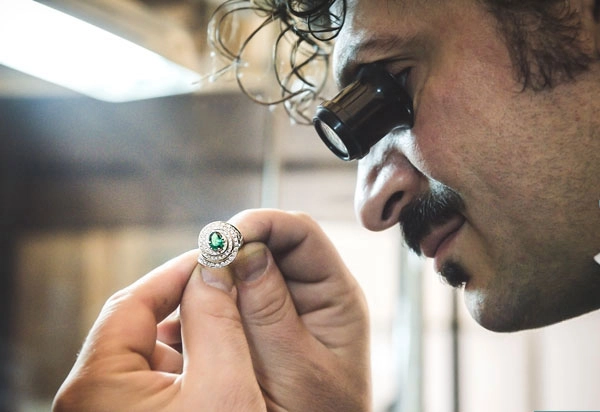
Jewellery care: the most common mistakes
Before talking about metals, stones and materials, it is useful to start with the most frequent mistakes.
- Neglect maintenance. A piece of jewellery worn often accumulates residue, dust, creams, sweat and minor signs of wear.
- To think that DIY is always enough. A domestic clean can help, but it does not replace a professional check-up.
- To use harsh detergents. Bleach, abrasive products, concentrated ammonia and chemical substances can ruin metals, stone or finishes.
- Store all the jewellery together. Rings, bracelets and necklaces can scratch each other if stored in the same space without separation.
- Ignore clasps, hallmarks and settings. A piece of jewellery may look clean but have loose or worn parts.
General tips for jewellery care
A piece of jewellery should be inspected regularly. Dull stones, scratched metal, stained pearls, weak clasps or worn settings are signs not to be ignored.
To reduce risks, there are some simple yet very important habits.
- Put on your jewellery after creams, perfumes, hairsprays and cosmetics.
- Avoid wearing them during sports, manual labour, at the beach, in the swimming pool or during housework.
- Place each piece of jewellery in its own case or in separate compartments.
- Regularly check links, clasps, claws and settings.
- Do not use hard toothbrushes, abrasive sponges, or rough cloths.
These rules apply to many items of jewellery, but each material requires specific care.
How to clean gold jewellery
For routine cleaning of gold jewellery, the most prudent method is to use lukewarm water and mild soap.
It is better to always work in a small container, not directly under running water: a ring or an earring can easily slip from your hands and end up down the drain.
After a brief soak, you can gently run a soft cloth or a very soft-bristled toothbrush over the less accessible areas. Then rinse carefully and dry with a cloth suitable for cleaning jewellery.
Avoid thermal shock, water that is too hot, harsh products and abrasive surfaces.
How to clean platinum jewellery
He platinum it is a durable and stable precious metal, but platinum jewellery also needs care.
For home cleaning you can use lukewarm water, mild soap and a soft cloth. If the piece of jewellery contains diamonds or other stones, it is important to pay attention to the settings.
When a platinum piece of jewellery is worn often, it may develop scratches, minor signs of wear or a loss of surface brilliance. In such cases, professional polishing can restore the jewellery to a neat and pristine condition.
To find out more, you can also read the dedicated guide to how to clean platinum jewellery.
How to clean white gold jewellery
Thewhite gold it requires special attention because many pieces of jewellery are covered with a layer of rhodium, known as rhodium plating.
Rhodium plating provides brilliance and a brighter white colour, but over time it can wear away, especially on areas most exposed to daily wear.
When the jewellery looks “yellowed”, it is not always dirty: often the rhodium plating has thinned and allows the natural colour of the underlying alloy to show through.
In this case, domestic cleaning is not enough. The intervention of a goldsmith is needed, who will be able to assess polishing and a new rhodium plating.
To find out more, you can read the dedicated guide to how to clean white gold jewellery.
How to clean silver jewellery
Thesilver tends naturally to oxidise on contact with air, moisture and certain substances. For this reason, it may darken or stain over time.
For routine maintenance you can use a soft cloth specifically for silver. In the presence of noticeable tarnish, dedicated products can be useful, but they must be chosen with care.
If the silver piece of jewellery contains enamel, stones, pearls, glued elements or delicate parts, it is best to avoid aggressive solutions and seek the advice of a goldsmith.
How to clean industrial jewellery and modular bracelets
Many industrial pieces of jewellery, such as modular bracelets or charms, can contain different materials: silver, enamels, glass, stones, synthetic pearls, oxidised parts or surface finishes.
In these cases one shouldn't treat everything as simple silver.
The most prudent solution is to consult the manufacturer's instructions or contact a professional, especially if the piece of jewellery has sentimental value or features delicate parts.
How to clean natural stone jewellery
I natural stone jewellery require specialist knowledge. Not all gemstones react in the same way to water, heat, ultrasound, steam or detergents.
Diamond, sapphire and ruby have good resistance, but other stones are much more sensitive.
Opals, turquoises, corals, ambers, lapis lazuli, malachites and porous stones can be damaged if treated with unsuitable products or prolonged immersion.
Before cleaning a piece of jewellery with stones, always ask yourself: do I really know the gemstone I am dealing with?
How to clean pearl jewellery
The pearl they require even more delicate care. They are made of organic materials and are vulnerable to acidic substances, perfumes, cosmetics, heat and excessive moisture.
To keep them in good condition:
- put them on after creams, perfumes and cosmetics;
- clean them with a soft, slightly damp cloth;
- avoid harsh detergents and prolonged soaking;
- do not store them in environments that are too dry or too hot;
- If you wear them often, have the thread checked at least once a year.
Pearl necklaces and bracelets worn frequently may need to be restrung periodically.
When to consult a goldsmith
House cleaning is useful for routine maintenance, but it is not enough in all cases.
It is better to go to a jeweller when:
- a ring has set stones;
- the claws appear worn or irregular;
- one closure is no longer secure;
- a stone moves;
- the white gold has lost its rhodium plating;
- the piece of jewellery exhibits deep scratches;
- there are pearls, opals or delicate materials;
- The piece of jewellery has significant sentimental or economic value.
A professional inspection makes it possible to check the cleanliness, polish, settings, solder joints, links, clasps and overall condition of the piece of jewellery.
The maintenance of bespoke jewellery
In my work, I consider maintenance to be part of the piece of jewellery's journey.
A bespoke piece of jewellery is not created to be forgotten after delivery. It must be able to last, be checked, maintained and passed down through time.
This is why regular care is important: not only to preserve a precious object, but to respect the history that that piece of jewellery holds.
Anyone wanting to find out more about how I work can visit the page dedicated to Guarantees.
You can also read the specific guides on platinum jewellery e white gold jewellery.
The first meeting is intended to clarify the direction, timetable and feasibility. It does not require an immediate decision.