
La history of jewellery It has ancient roots. Long before the jewel became a precious ornament, a social symbol or a promise of love, man used natural materials to create signs to wear.
The first ornaments date back to the Upper Palaeolithic, between 40,000 and 10,000 BC. They were objects that were only simple in appearance, but already capable of expressing identity, belonging, protection and beauty.
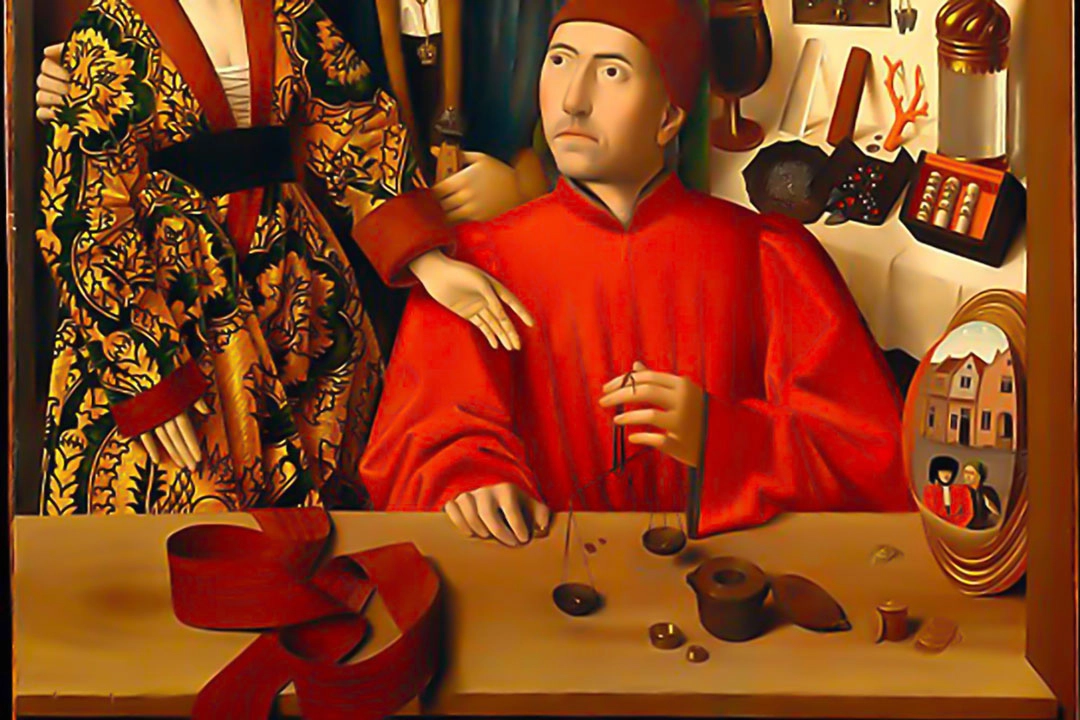
What were the first pieces of jewellery made of?
The earliest jewellery in history was probably necklaces, bracelets and pendants made from materials available in nature: teeth, horns, tusks, bones, shells and stones.
These items were drilled, engraved or worked with rudimentary tools, such as flint or obsidian burins. The primitive “jeweller” was often a skilled stonecutter, capable of transforming raw material into an object to be worn on the body.
Already at this stage, the jewel was not merely decoration. It could indicate role, strength, group membership, ritual value or symbolic protection.
The Golden Age
The history of gold has accompanied mankind for thousands of years. It was probably one of the first metals to be used, even before copper, thanks to its beauty, its ductility and the possibility of finding it in nature in a relatively workable form.
With the improvement of techniques, gold made it possible to elevate the quality of ornaments. From a simple rare and luminous material, it progressively became a symbol of power, sacredness, wealth and continuity.
In the East and in ancient Egypt, jewellery was developed comprising gold, silver, hard stones and glass paste. The first significant evidence dates back as far as the first half of the 3rd millennium BC.
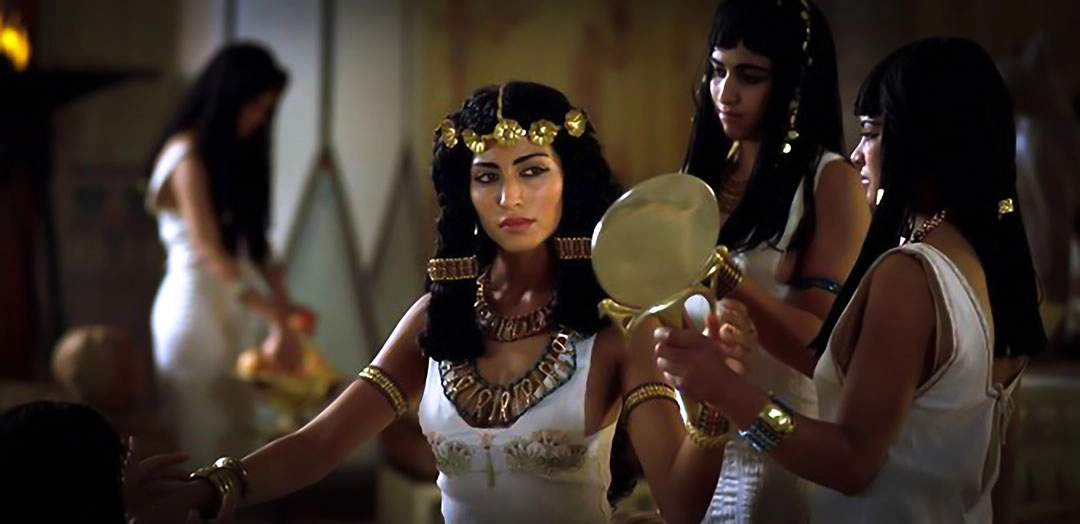
Jewellery in Ancient Egypt
Egypt represents a fundamental milestone in the history of jewellery. Opulence, technique and creativity come together in artefacts destined for elites, the pharaonic families and ritual contexts.
Tutankhamun's tomb is one of the best-known examples of the standard achieved by Egyptian goldsmithing: gold, enamel, stones, religious symbols and protective figures interact in objects of extraordinary visual power.
The Egyptians developed and perfected important techniques, including lost-wax casting and craftsmanship that allowed for a more complex production of precious and ritual objects.
The jewel in ancient Greece
In ancient Greece, jewellery was often characterised by balance and restraint. The lines could be sober, refined, and built around harmonious proportions.
Among the most representative examples are tiaras made of thin gold leaf, rings with inset gems, disc earrings, and filigree or granulation work.
During the Hellenistic period, tastes changed. Jewellery became richer, more theatrical, and more complex. Conquests, cultural exchanges and the opening up to new territories brought diverse forms, stones and influences.
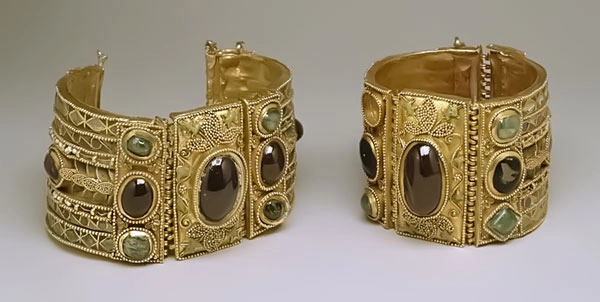
An important role is also played by Cretan and Mycenaean jewellers. Their artefacts evoke natural elements, such as flowers, olive branches, wings and symbolic figures. Finds in tombs show jewellery, weapons, vases, glass pastes and pendants in gold foil with motifs inspired by the animal and mythological worlds.
The Etruscans and technical sophistication
A position of great prominence in the history of jewellery must be reserved for the Etruscans.
Etruscan goldsmiths were capable of producing creations of the highest technical refinement, using techniques such as repoussé, stamping and above all granulation granulation.
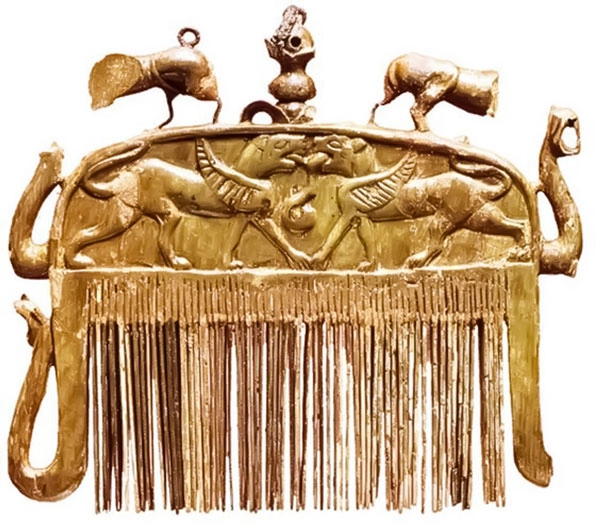
Granulation consists of applying tiny spheres of gold to a surface, creating very fine and complex decorations. Even today, this technique is considered one of the most fascinating testimonies to ancient goldsmithing skill.
The jewel in ancient Rome
The Etruscans also deeply influenced the goldsmith's art of ancient Rome.
In Rome, jewellery takes on a very strong social role. Rings, in particular, become marks of distinction and help to differentiate classes, roles and allegiances.
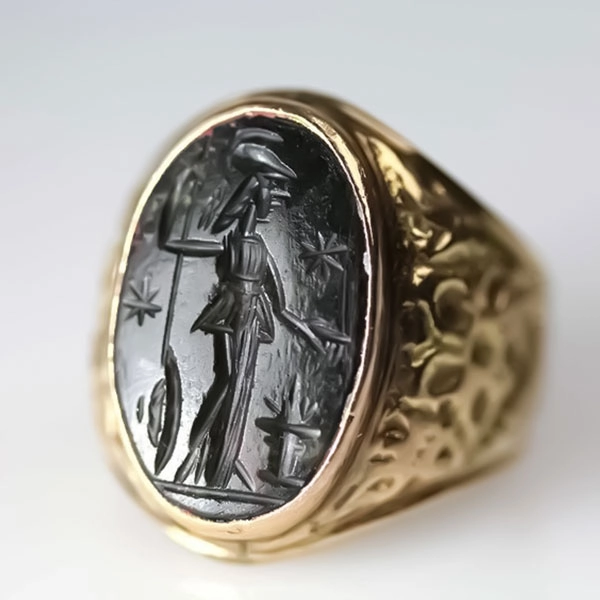
It is interesting to remember that Roman artisans were already organised into guilds and specialisations: chasers, gilders, goldbeaters, pearl merchants and professionals linked to the different phases of precious metalworking.
Roman jewellery was not merely decorative, but could communicate rank, wealth, legal status, devotion or family affiliation.
The birth of the engagement ring
According to tradition, ancient Rome was also one of the places where the ring began to be used as a symbol of Engagement.
The ring, due to its circular shape, naturally lent itself to representing continuity, connection and promise. Over time this meaning has transformed, crossing different cultures and eras, right up to the engagement ring as we know it today.
History, however, reminds us of an important thing: prior to modern mass production, jewellery was often an object tied to the hand, to technique, to the individual and to the context in which it was created.
From ancient history to the bespoke jewel
Looking at the history of jewellery means understanding that man has always sought objects capable of representing something more than mere matter.
Teeth, shells, gold, stones, rings, tiaras and pendants have endured for millennia because they were not merely things to be worn. They were signs, symbols, stories, protections, promises.
It is this thread that extends all the way to contemporary bespoke jewellery: creating something that is not only beautiful, but holds a precise meaning for the person wearing it.
The second part of this journey continues in the article dedicated to history of jewellery from Rome to the Middle Ages.
Anyone wishing to explore the relationship between technique, meaning and design in greater depth can visit the dedicated page at Bespoke personalised jewellery or the one dedicated to narrative jewellery.
The first meeting is intended to clarify the direction, timetable and feasibility. It does not require an immediate decision.