
Aquamarine: A Guide to the Blue Gemstone for Choosing a Bespoke Piece of Jewellery
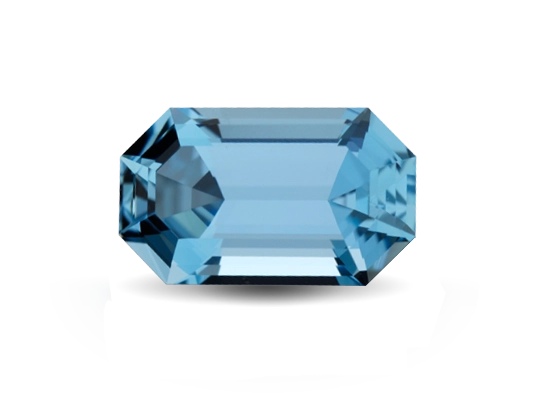
Aquamarine is one of those gemstones that doesn't need to raise its voice: it convinces with its transparency, a fresh luminescence, and a blue that can range from delicate blue to a deeper blue-green. In my work, I consider it an elegant stone, suitable for those who desire a bright but not ostentatious piece of jewellery, with a marine character that is clean and highly recognisable.
This guide is designed to help you read aquamarine before you choose it: colour, cut, inclusions, treatments, care, and use in bespoke jewellery. It is not a sterile lab report, but a practical journey to understand what to look for when a gemstone moves from the tray to the setting.
What is aquamarine
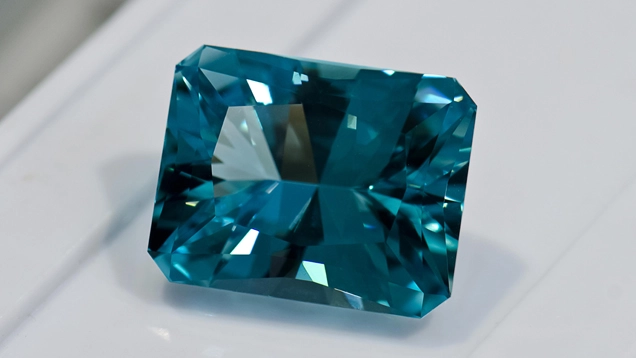
Aquamarine is the blue to blue-green variety of beryl, the same mineral group to which emerald also belongs. The name evokes seawater: a poetic reference, but also a very effective one for describing its visual identity. Its beauty depends on the balance between colour, transparency, and cut; when these three elements interact well, the stone becomes clear, brilliant, and refined.
Unlike other coloured gemstones, aquamarine is often available in relatively clean, importantly sized crystals. This allows for generous cuts, elegant geometric shapes and, in the best cases, very luminous surfaces. For this very reason, it is an interesting gemstone for both important rings and for pendants, earrings and bespoke creations.
Month, anniversary, and the meaning of the gift
Aquamarine is the traditional birthstone for March and is associated with the 19th wedding anniversary. In jewellery, this makes it suitable for a birth gift, a birthday, a couple's anniversary or an item that discreetly tells a personal milestone.
When symbolic value is important, I recommend starting with the person even before the stone: complexion, daily style, way of wearing jewellery, relationship with colour. In this sense, aquamarine works well in narrative jewellery, because its azure communicates memory, light and calm without the need for explicit symbols.
Geological origin and deposits
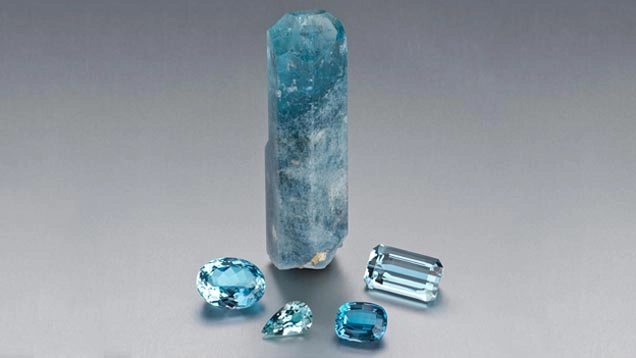
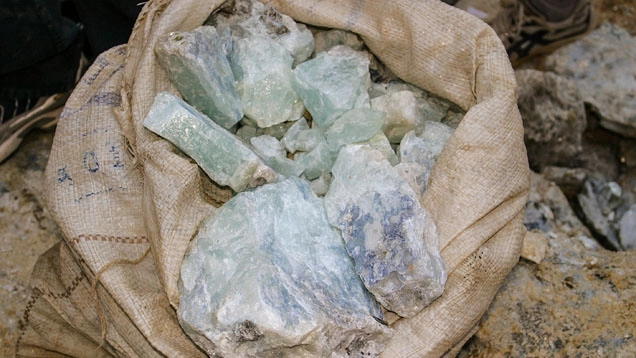
Aquamarine forms in geological contexts compatible with beryl, often in pegmatitic environments where crystals can grow with well-defined prismatic shapes. Some rough specimens clearly show this natural architecture: an elongated body, regular faces, and a transparency that already hints at the potential of the cut stone.
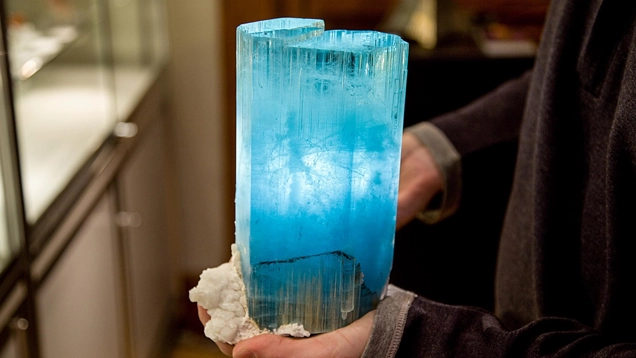
Historically known areas include Brazil, particularly Minas Gerais, and mountainous regions like Pakistan's Karakoram. Some African sources are also valued for their intense colours and not necessarily large sizes. However, when choosing a stone for jewellery, origin should not override the observation of quality: colour, transparency, cut, and documentation remain more important than a geographical name used as a commercial draw.
Colour and visual characteristics
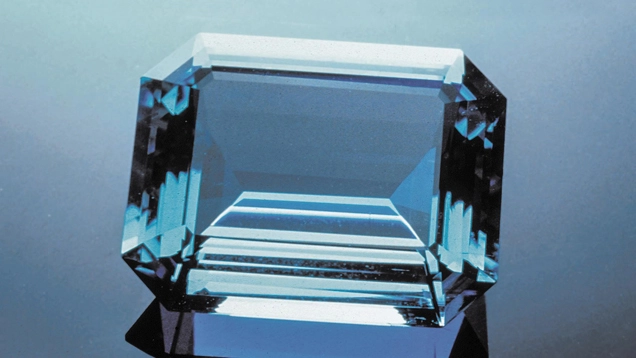
The colour of aquamarine can be blue, slightly greenish-blue, greenish-blue or blue-green. The most sought-after stones display a medium to medium-dark blue, with moderately strong intensity and even distribution. Many aquamarines, however, are naturally light: this is not a defect in itself, but it does change the type of project it is best suited for.
A very pale gem can look stunning in a luminous pendant or delicate earrings; for an important ring, however, I often look for more evident saturation, because the stone needs to remain legible both from a distance and under different lights. Aquamarine can also show pleochroism: viewed in different crystalline directions, it can appear almost colourless or more decidedly blue. The cut also serves to enhance this favourable direction.
The most desirable colour is a medium to medium-dark blue, of moderately strong intensity and with hues that can range from pure blue to slightly greenish blue. According to GIA, the most appreciated shades are moderately intense, blue to blue-green with even colour distribution.
Gemmological technical data
| Species / variety | Aquamarine beryl |
|---|---|
| Chemical formula | Be3Al2Si6O18 |
| Colour | From blue to bluish-green, often in light tones. |
| Refractive index | Approximately 1.577–1.583 |
| Birefringence | Around 0.005–0.009 |
| Specific gravity | Around 2.72 |
| Mohs hardness | 7,5–8 |
| Anniversaries | March birthstone; 19th wedding anniversary |
Dichroism: The gem is dichroic, meaning it shows slightly different hues depending on the direction of observation. A well-oriented cut takes this characteristic into account to enhance the colour.
Quality factors: how to evaluate an aquamarine
Colour
Colour is the first element that catches the eye. The finest aquamarines lean towards a purer, more intense blue, sometimes with a slight green component. A green hue does not automatically make the stone inferior; it can be very elegant, especially if the colour is uniform and consistent with the jewellery's design. However, it is good to distinguish between personal taste and commercial value.
Transparency and inclusion
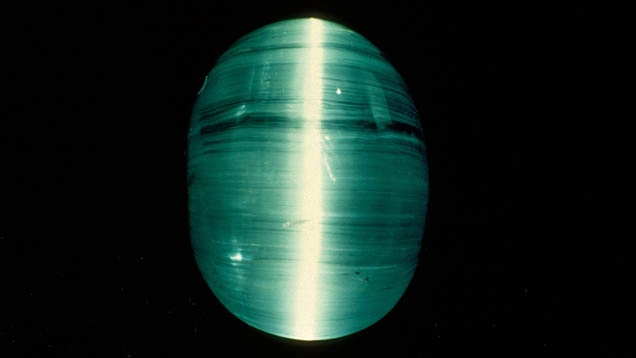
In good quality faceted aquamarines, a stone that is clean to the naked eye is often expected. Visible inclusions, a milky appearance, or visible fractures can reduce the value, but do not always eliminate interest: some more included stones can work well as cabochons, carvings, or elements with a more artistic character.
Cut
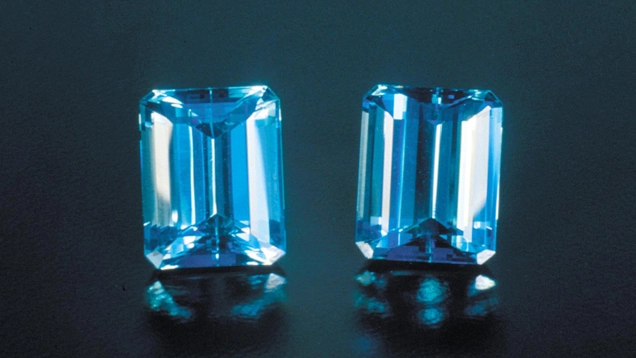
The cut is crucial because aquamarine, often being light in colour, does not forgive weak proportions: overly open windows, ineffective pavilions or dull facets will diminish the stone's presence. Emerald, oval, round and rectangular cuts are very frequent; the emerald cut, in particular, enhances the gem's geometric elegance and transparency.
Carat weight
Aquamarine can also be available in generous sizes. However, bigger doesn't always mean better. For a ring to be worn often, the size, height of the stone and the protection of the setting must remain proportionate to the hand and lifestyle. For very large gemstones, a pendant or a more protective setting might be a more balanced choice.
Practical tips for buying an aquamarine
When I accompany a client in their choice, I always compare multiple stones side-by-side. Aquamarine should be viewed against light and dark backgrounds, in natural light and under bench lighting, because the saturation can change significantly. A stone that looks intense in a photograph might appear paler in person; conversely, a delicate but well-cut gem can have a surprising brilliance once set.
For a prudent choice, I recommend checking:
- uniformity of colour, without any areas that are too pale;
- transparency and absence of visible inclusions if the stone is faceted;
- cut proportions and brilliance in the centre of the gemstone;
- Coherence between size, frame type and everyday use;
- Clear documentation on the gem's identity and any detectable treatments.
If the stone is intended for an important project, the documentation isn't a bureaucratic detail: it's part of the journey of trust. For this reason, when necessary, I supplement the choice with an assessment consistent with my Method and my Guarantees, This way, the customer knows what they are buying and why.
Treatments, synthetics and imitations
GIA includes aquamarine among the gemstones for which processes exist that can modify colour, apparent clarity, or durability, referring to the general section dedicated to gemological treatments.
Heat treatment is common in aquamarine and is used to achieve a bluer appearance by reducing the greenish component. In many cases it is considered stable, but it must be declared when known or detectable. Fracture filling is rarer and more delicate: in that case, cleaning must be much more cautious and techniques such as ultrasound or steam should be avoided.
There are also synthetic materials or imitations that can resemble aquamarine. In the GIA classification, a distinction is made between synthetic gems, which have substantially analogous chemical, physical, and optical properties to natural gems, and imitations, which only reproduce their appearance, whether natural or artificial. Treated blue topaz, for instance, can resemble its colour but has a different nature, history, and market. For this reason, I never rely solely on the trade name or generic definitions like “AAA”: I prefer to observe the stone, assess its behaviour, and, when necessary, request gemmological documentation.
Heating is the most common treatment: heat can transform yellowish-green beryl into blue aquamarine or.
Care and maintenance
With a hardness of 7.5–8 on the Mohs scale, aquamarine is a gemstone suitable for jewellery and can also be used in rings, provided the setting is intelligently designed. However, this does not mean it is indestructible: impacts, abrasions, and rubbing against harder gemstones can mark the surface.
For routine cleaning, lukewarm water and mild soap are the safest choice. Ultrasonic cleaners and steam may only be used when the stone is free of fractures, liquid inclusions, or fillings; if in doubt, it is best to avoid them. I also advise against exposure to intense heat during repairs or laboratory work, unless the stone has been adequately removed or protected. These indications are in line with general GIA recommendations for gemstone care, particularly for species with similar hardness and potential inclusions or treatments.
Aquamarine in bespoke jewellery
Aquamarine has an elegant and bright presence, ideal for those looking for a coloured but not aggressive gemstone. In a Personalised jewellery with coloured gemstone it can become the absolute protagonist or dialogue with diamonds, white gold, platinum or yellow gold, depending on the desired result.
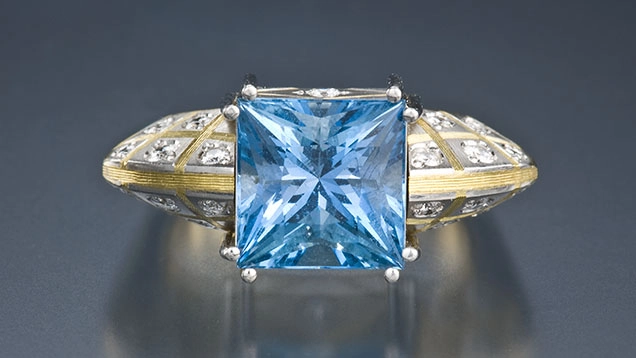
For a Bespoke Engagement Ring, I value it on a case-by-case basis. It is more durable than many delicate gemstones but still requires a well-protected setting, especially if the wearer plans to wear the ring every day. Solid prongs, partial bezels, not-too-exposed profiles, and periodic maintenance can make a difference.
In pendants and earrings, however, aquamarine can afford more elongated cuts, larger stones, and dramatic geometries. Here the risk of impact is lower and there is more space for light to pass through the gem. When I design a creation with aquamarine, I always try not to make it heavy: its strength lies in its clarity.
Common Errors to Avoid
Error 1: look only for the most intense blue
Deep blue is highly sought after, but it's not the only valid choice. A lighter shade can be refined if the cut is good and the jewellery is designed to enhance the stone's light.
Error 2: Confusing aquamarine and blue topaz
The colour may be similar, but the two gemstones do not have the same commercial value, natural rarity, or history. The very low price for a large, very blue stone always warrants verification.
Error 3: Ignore cut
A light-coloured stone with a weak cut can appear empty in the centre. In aquamarine, the cut is not a technical detail: it is what transforms the delicate colour into a visual presence.
Error 4: using “AAA” as an absolute guarantee
Grades such as AAA, AA, or A are not universal standards for aquamarine. They can be internal commercial classifications, useful only when accompanied by clear criteria and actual comparison between stones.
Error 5: choosing the frame afterwards, without a plan
A gemstone should be chosen with the finished piece of jewellery already in mind. The height, shape, angles, metal colour and the wearer's style all influence the final result as much as the carat weight.
Frequently asked questions about aquamarine
Is aquamarine suitable for an everyday ring?
It can be, as it has a Mohs hardness of 7.5–8, but it needs to be set carefully and treated with attention. For everyday wear, I recommend a protective setting and periodic checks.
What is the best colour of aquamarine?
Commercially, medium to medium-dark blue shades, preferably uniform, are highly sought after. However, a lighter stone can be very elegant if well-cut and consistent with the jewellery.
Is aquamarine always treated?
Not always, but heat treatment is common to make the colour bluer. It's generally stable, whereas any fracture fills require more caution.
How do you clean an aquamarine piece of jewellery?
The safest method is lukewarm water with mild soap and a soft cloth. Steam and ultrasound should be avoided if the stone has fractures, liquid inclusions, or delicate treatments.
Aquamarine and sky blue topaz are they the same thing?
No. They may have similar colours, but they are different gemstones. Commercially available blue topaz is often obtained through treatment, whereas fine aquamarine owes its interest to the natural variety of beryl and the quality of the individual specimen.
Does origin increase the value of aquamarine?
It may be interesting, but it shouldn't be the main criterion. Colour, transparency, cut, proportionate size, and documentation are more important than a provenance used purely as a sales gimmick.
Do you want to choose an aquamarine for a bespoke piece of jewellery?
If you're considering an aquamarine, the point isn't to find “the bluest stone” in absolute terms, but the right gem for the piece of jewellery you'll wear. I can help you understand the differences between various stones, figure out which setting best enhances them, and build a project that's consistent with your style, budget, and actual use.
You can also continue the journey by consulting the’Gemstone Encyclopaedia, confronting the aquamarine with other coloured stones before deciding.
The GIA assumes no responsibility for the content of this article, as the Italian translations have not been checked by the GIA. I am not a GIA associate and the original reference content comes from the site www.gia.edu.