
TheMimosa Ring is born from the desire to create a Personalised Jewellery Durable.
It's a ring in white gold, diamonds and emerald, designed starting from an initial inspiration from the client and transformed, step by step, into a bespoke creation.
This story tells of an important difference: that between an industrial jewel designed to be replicated and a handcrafted jewel designed to accompany a person over time.
From inspiration to creation
The Mimosa Ring was born from the desire to reinterpret an existing model, chosen by the client as a starting point.
The initial reference was not copied. It was analysed, discussed and transformed into a new project, more aligned with the needs of the person who would wear the jewellery.
There is a decisive difference in.
For the Mimosa Ring, the choice fell upon white gold, side diamonds and a central emerald with an octagon cut.
Gold jewellery and industrial production
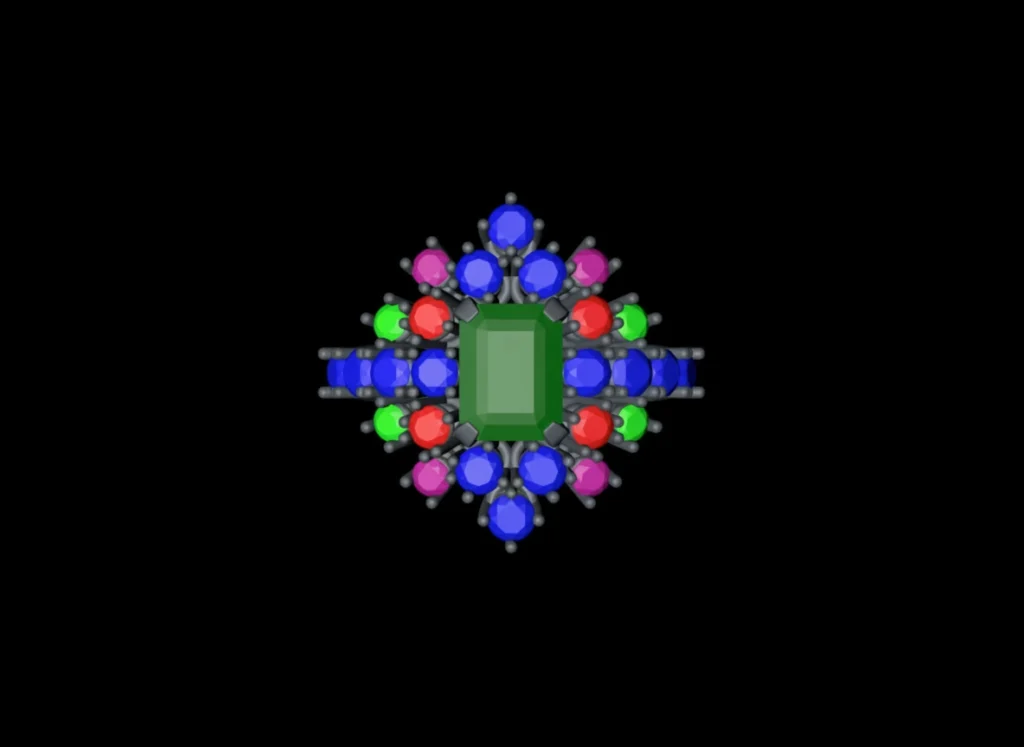
In the industrial world, every gram often counts in the wrong way.
Many productions reduce the thickness of the shank, claws, settings, and structures to keep down metal weight and optimise profit margins.
An artisan, however, doesn't just think about saving materials. They consider the future life of the jewellery: the stability of the gemstones, the durability of the ring, its comfort, maintenance, and its ability to last through the years without losing its identity.
This is where the real difference is made.
Industry often designs to replicate. The artisan designs to last.
3D design as a shared language
3D design played a central role in the creation of the Mimosa Ring.
Through modelling, the client was able to better understand the proportions, thicknesses, volumes, and gemstone arrangement before the final realisation.
This passage is important because it transforms an abstract idea into something visible.
The client doesn't have to imagine everything on their own. They can observe, compare, request changes, evaluate different solutions, and participate more consciously in the creation of the jewellery.
In my method, 3D design does not replace craftsmanship. It prepares it, clarifies it, and makes it more shareable.
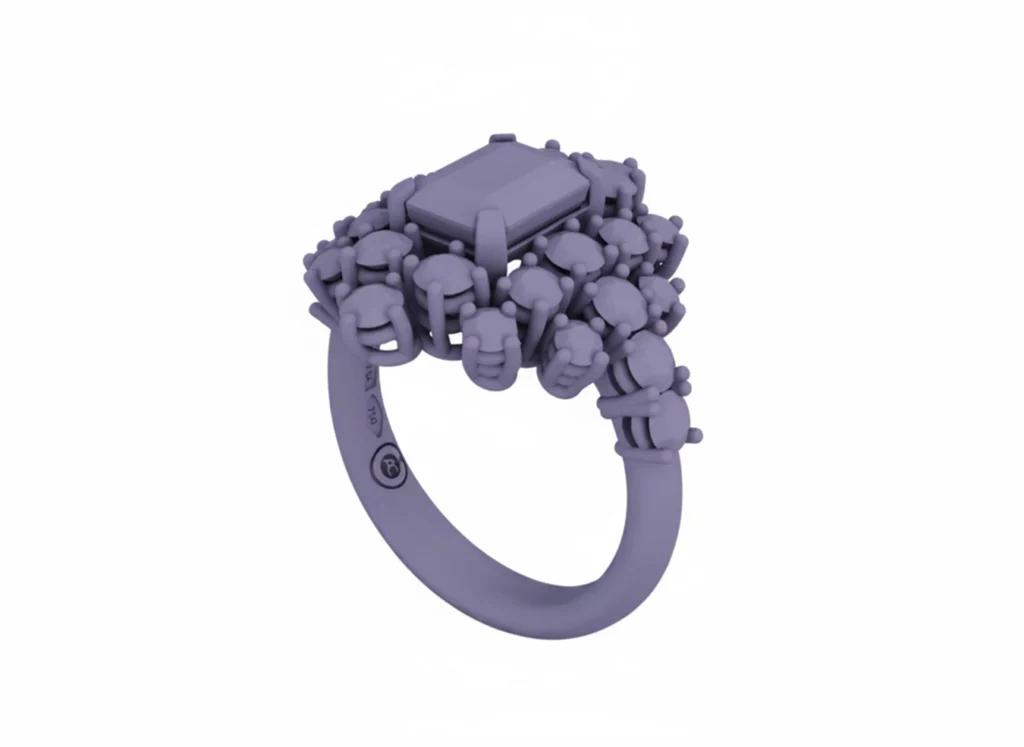
The prototype before forging
The resin prototype allows observation of the jewel at full scale before it is realised in precious metal.
It is an important guarantee, especially in custom projects.
The client can assess the presence of the ring, its proportion, the overall balance, and its coherence with the initial idea.
For me, this step is not just technical. It's also a moment of trust: the project becomes concrete, verifiable, understandable.
Harmony, symmetry and final decision
During the review phase, the client was able to compare two versions of the project.
A first solution adopted the more random arrangement of the bezels present in the reference industrial model. A second version, however, proposed a more symmetrical, ordered, and balanced distribution.
The choice was immediate: harmony became a project.
This moment perfectly illustrates the value of a personalised journey. The client isn't subjected to a pre-determined solution. They participate in the choice, understand the differences, and arrive at a more informed decision.
The value of duration over time
The word Duration It encompasses three fundamental dimensions.
Physical durationthe structural integrity of the jewellery, given by calibrated thicknesses, solid claws and materials that are not excessively lightened.
Economic lifeThe possibility that the jewellery retains value because it is not designed to be quickly replaced, but rather to be cared for and passed down.
Symbolic durationthe ability to retain its original personal meaning over time.
A well-designed artisanal ring doesn't just aim for an immediate effect. It must be beautiful today, and also solid tomorrow.
For me, longevity isn't a technical detail. It's an act of responsibility towards whoever will wear the piece of jewellery.
White gold, diamonds and emerald
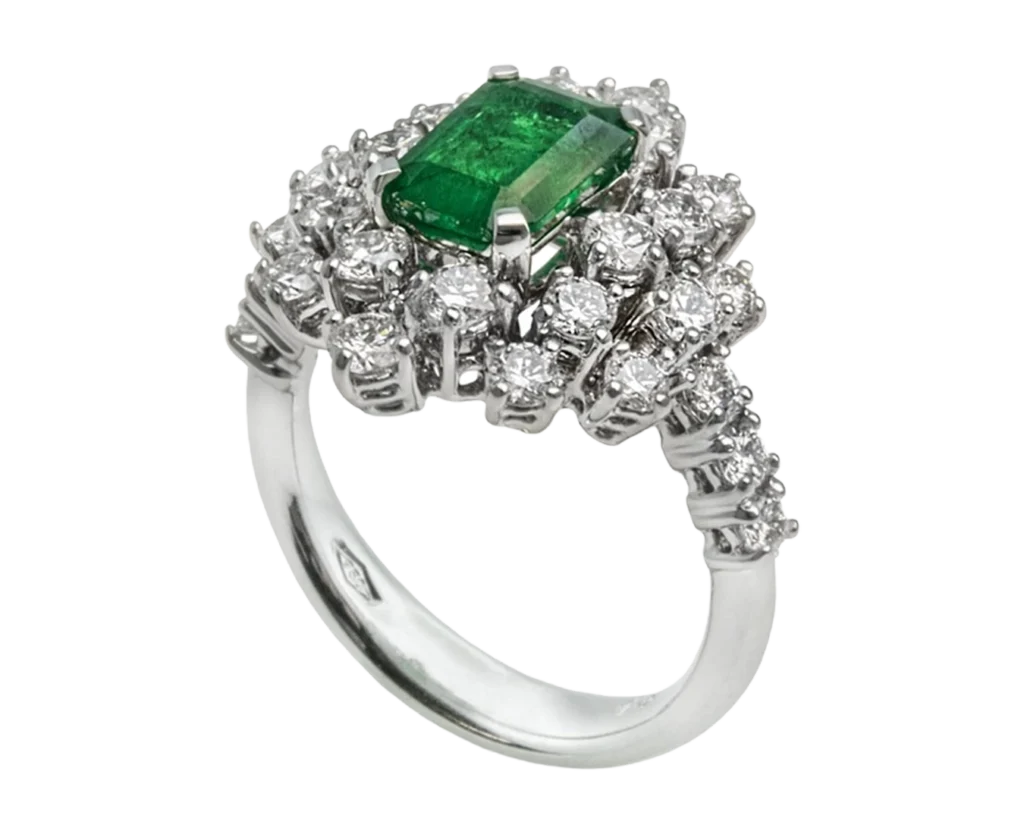
The Mimosa Ring combines white gold, diamonds and a central emerald.
White gold offers a bright, contemporary base. The side diamonds complement the main stone and add rhythm to the composition. The emerald, with its intense green, becomes the visual and emotional centre of the jewel.
In a project of this nature, every element must communicate with the others.
The central gem must not appear to be resting on any old structure. The setting must support it, enhance it, and protect it.
Why choose a personalised piece of jewellery
Choosing a personalised piece of jewellery means valuing true worth.
It's not just about having something different from what's on display. It's about building an object that's consistent with the person who will wear it.
Materials, geometry, comfort, structure, proportions, maintenance, and meaning must work together.
A bespoke piece of jewellery takes time, but it is precisely that time which allows for the avoidance of hasty choices and weak solutions.
The artisanal process is pragmatic and human: every technical decision arises from listening, and every millimetre has a reason.
Craftsmanship, technology and awareness
The Mimosa Ring shows how craftsmanship and technology can coexist.
3D design, rendering and prototyping do not detract from the value of the goldsmith’s work. On the contrary, they enable the final piece to be crafted with greater precision and clarity.
Technology helps us see things sooner. Craftsmanship enables us to transform that vision into something precious.
When these two worlds work well together, the customer ends up with a piece of jewellery that is more thoughtfully designed, more carefully crafted and more consistent.
A jewel built to stand the test of time
The Mimosa Ring is the symbol of an approach that unites art, technique, and time.
It is not an item designed to be replaced after just a few years. It is a piece of jewellery made to be worn, looked after, checked and passed down through the generations.
Lasting beauty does not come about by chance.
It stems from design choices, the right thicknesses, secure settings, balanced proportions and a clear vision of the future of jewellery.
Creating a bespoke piece of jewellery
Anyone wishing to create a bespoke piece of jewellery should start by asking themselves a simple question: what should this piece of jewellery represent?
It could be an anniversary, a promise, a new beginning, a memory, a personal transformation or the desire to give a fresh twist to an idea we’ve seen before.
From there, a process can begin that involves listening, planning, selecting materials, modelling, prototyping and production.
You can find out more on the page dedicated to Bespoke personalised jewellery or the one dedicated to narrative jewellery.
To see more examples, you can also visit the section Creations.
The first meeting is intended to clarify the direction, timetable and feasibility. It does not require an immediate decision.