
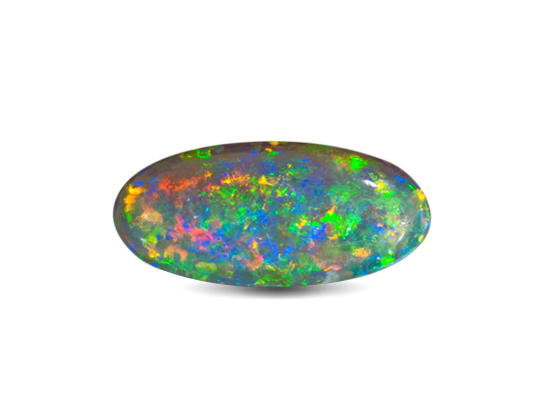
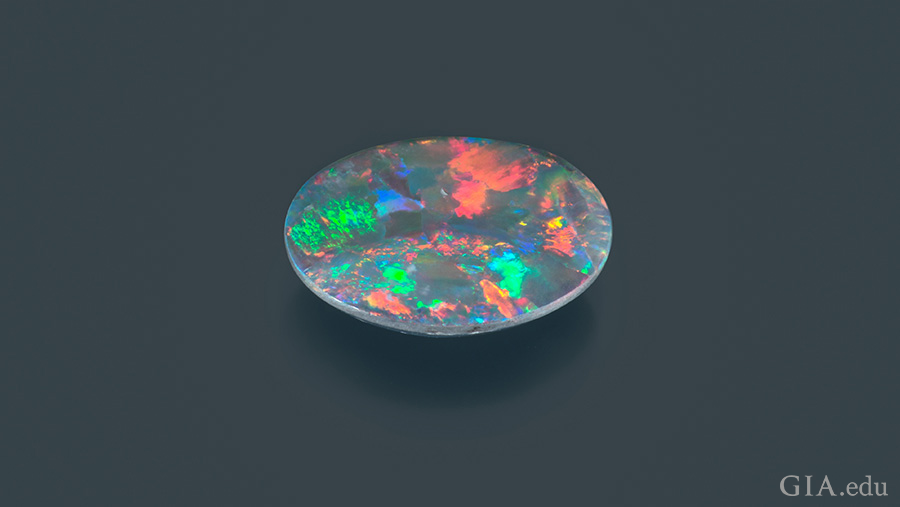
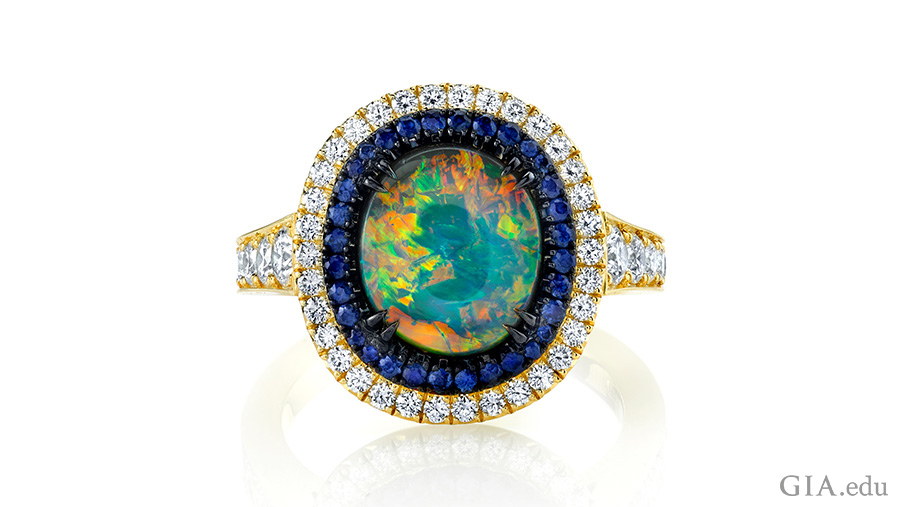
The refined opal shows why this gemstone is often cut as a cabochon: the curved surface enhances colour, light and depth.
Opal: the gem of play of colour
The opal is a gemstone that does not lend itself to being judged at a single glance. It changes with the angle of the light, the background against which it is observed and the quality of the cut. For this reason, when I guide a client in choosing an opal, I never start from the colour alone: I observe the movement of the flashes of colour, the stability of the material, the transparency, the most suitable setting and the type of jewellery that is to hold it.
From a gemmological point of view, opal is hydrated silica, with the formula SiO2·nH2O. Its most beloved feature is the colour scheme, that is the appearance of spectral flashes that can resemble fireworks, galaxies, lightning or luminous jellyfish. Not all opals show this: precious opals possess it; common opals do not.
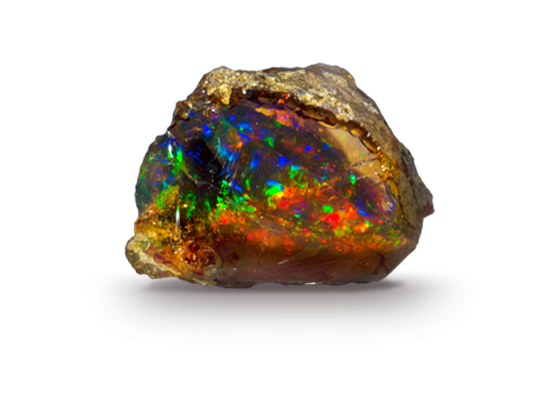
What is opal
Opal is not a crystalline gemstone in the classical sense: it is an amorphous form of hydrated silica. In the precious material, tiny silica spheres are arranged in an orderly fashion; when light passes through this structure, it is scattered and separated into spectral colours. It is this phenomenon that creates the shifting flashes typical of opal.
Many opals are cut into cabochon, because a curved and well-polished surface helps to show the play of colour from multiple angles. The choice of cut, however, is never neutral: in a quality opal, the lapidary seeks to preserve the liveliest area of the gem, even when this means preferring a freeform shape over a standard commercial size.
History, Symbolism and Occurrences
Opals have an ancient history, full of charm and superstition. The Romans considered it a precious stone capable of capturing the colours of many other gems. In various traditions it has been associated with hope, purity and truth; other beliefs, such as the idea that it brings bad luck to those not born in October, are much more recent and do not belong to a true gemmological tradition.
It is one of the birthstones for October and it is also connected to the 14th wedding anniversary. For a personal gift it can be an intense choice, especially when the jewel wants to recount a light, a memory or an important transition. In this sense the opal interacts well with the narrative jewellery, because every stone has a unique pattern.
Geological origin and main deposits
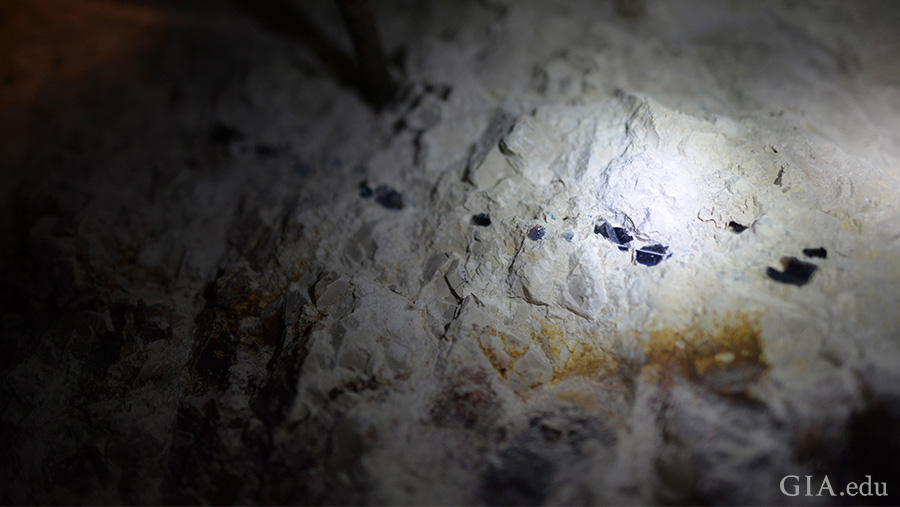
Opal is formed when silica-rich water penetrates rock crevices and layers. With evaporation, the silica is gradually deposited, giving rise to nodules, veins or thin opal-bearing layers. This process can take place in sedimentary or volcanic environments and explains the wide variety of appearances from one opal to another.
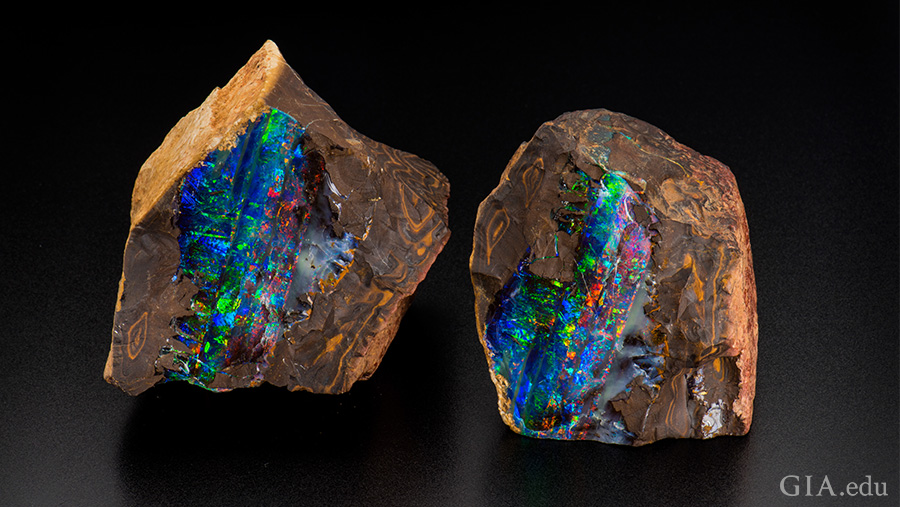
Australia is historically the most important reference for opal, with famous areas such as Lightning Ridge, Coober Pedy, Mintabie, Andamooka, White Cliffs and Queensland for boulder opal. Other important origins include Ethiopia, Mexico, Brazil, Honduras, Indonesia, Madagascar, Peru, Turkey, the United States and some areas of central Europe. When evaluating, however, origin alone is not enough: colour quality, intensity, pattern, stability and cut remain decisive.
Play of colour: why the opal changes
The play of colour stems from the diffraction of light. When silica spheres are of a favourable size and arrangement, they separate light into different colours. Smaller spheres tend to produce violet-toned hues, whilst larger spheres can generate flashes of red. For this reason, it is not enough to simply say “coloured opal”: one must observe which colours appear, how bright they are, and whether they remain visible when the gemstone is rotated.
In the laboratory and in the studio, the opal should be viewed against a dark background, with controlled lighting and slow movement. The background allows the contrast to be read better, whilst the rotation reveals whether the play of colour is present only in one area or whether it runs convincingly through the gem.
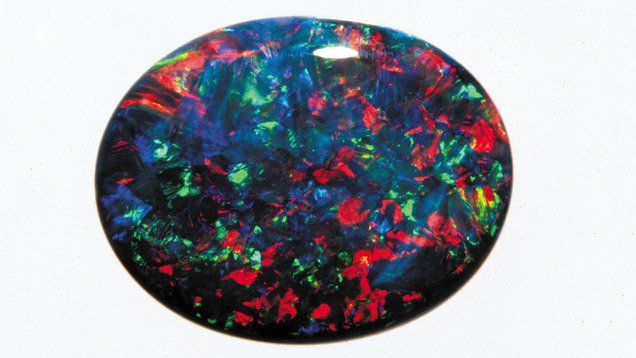
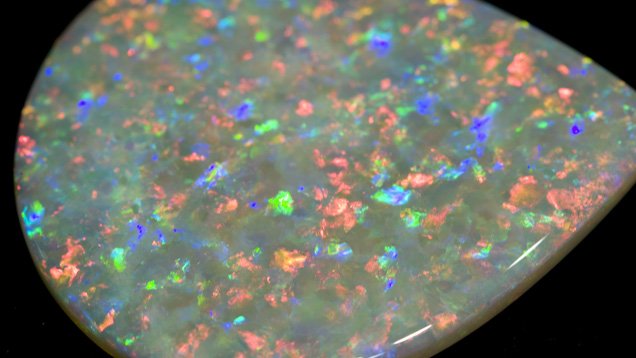
Main types of opal
Opals can be classified in various ways, but for a customer who has to choose a piece of jewellery it is useful to start from a few main families.
| Type of opal | Features |
|---|---|
| White or light opal | From translucent to semitranslucent, with a play of colour on a light or greyish background. |
| Black opal | From translucent to opaque, with a play of colour on a dark background. |
| Fire opal | Transparent or translucent, with a yellow, orange or red body colour; may not show play of colour. |
| Boulder opal | Opal associated with the host rock, which may remain part of the finished gemstone. |
| Crystal water opal | From transparent to semi-transparent, with a light or watery background. |
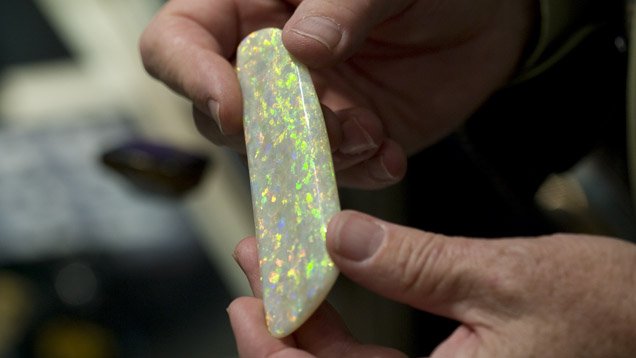
Gemmological technical data
| Property | Indicative data |
|---|---|
| Material | Amorphous hydrated silica |
| Chemical formula | SiO2·nH2O |
| Colours | All colours; in noble opals the visual value depends on the play of colour |
| Refractive index | Approximately 1.37–1.47 |
| Birefringence | absent |
| Specific gravity | Around 2.15, with even wide variations |
| Mohs hardness | 5–6,5 |
| Cleavage | Agreed; opal is amorphous and does not feature crystalline cleavage planes like many crystalline gemstones |
| Tenacity | From very poor to fair; requires protection from knocks, scratches, heat and dryness |
| Water content | It can reach up to around 20% in the silica structure |
Quality factors: how an opal is evaluated
An opal is not chosen using the same criteria as a diamond or a classic transparent gemstone. There are three main factors: colour, pattern e clarity. To these are added the cut, proportions, stability and intended use of the piece of jewellery.
In my work I proceed with a simple method: I identify the type of opal, evaluate the quantity and quality of the play of colour, observe the transparency, look for any fractures, cavities or dull zones, and finally consider whether the cut protects and enhances the best part of the stone.

Background colour and colour play
The background colour, or body colour, can be light, dark, orange, brown, transparent or milky. But what distinguishes precious opal is the strength of the play of colour. The flashes must be vivid, distinct and distributed in an interesting way. Traditionally, red flashes are highly prized, followed by orange and green, but the final choice also depends on personal taste and the jewellery design.


the design of light
The pattern describes the way the play of colour is arranged on the stone. It can be fine and pin-point, with small sparkles, or formed by larger, closer areas. Among the most commonly used terms are pinfire, harlequin or mosaic, flame and peacock. In general, larger, brighter and well-distributed patches of colour are preferred over weak or isolated zones.


Clarity, transparency and stability
The clarity of the opal relates to transparency, inclusions, fractures, surface cavities and the presence of matrix. Some opals are prized precisely for their opacity and dark background, others for their transparency. What should be avoided are flaws that weaken the gemstone or make it unstable.
A delicate aspect is the crazing, a network of micro-fractures that can appear when the opal loses moisture or is subjected to conditions that are too dry, hot or bright. For this reason, I never recommend leaving an opal exposed for long periods in hot display cases, near sources of heat or in extremely dry environments.


Cut and carat weight
The cut must respect the nature of the stone. A well-proportioned cabochon helps the play of colour to show from multiple angles; a dome that is too flat can make the gemstone more vulnerable, while one that is too high can create setting problems. Higher quality opals are often cut into freeforms, because the objective is to preserve the best possible play of colour.
Opal has a relatively low density compared to many other gemstones: even stones of significant weight can be comfortable to wear, provided the setting is carefully designed. The most frequent commercial sizes for jewellery cabochons include formats such as 6×4, 7×5 and 8×6 mm, but unusual specimens often require a custom design.


Treatments, synthetics, imitations and assembled opals
Opal can be treated to improve colour, appearance or durability. Possible treatments include impregnation with oil, wax or plastic, and surface modifications. When buying, it is important always to ask for clarity: a treatment is not necessarily a problem, but it must be declared and understood.
Synthetic opals and imitation materials also exist. Furthermore, in jewellery, one often encounters double-barrelled shotguns e three-seater sofathin layers of opal applied to a base, sometimes with a transparent covering. They can be pleasing and affordable, but they should not be confused with a solid opal. Along the path of Method and Guarantees, this kind of distinction is essential in order to make an informed choice.
Practical advice before purchase
Before choosing an opal, I recommend observing it in motion. A photograph can suggest colour and atmosphere, but it does not replace rotating the stone under controlled light. It is important to check whether the play-of-colour remains vibrant from multiple angles, whether there are dead spots, whether the body tone is consistent with the type of opal, and whether the cut truly protects the gemstone.
For a Personalised Jewellery, the opal should be chosen alongside the design. A pendant can accommodate more delicate materials; a ring requires greater protection. For everyday use, especially if you think of a Bespoke Engagement Ring, the opal must be evaluated with caution: it is beautiful, but it does not have the durability of sapphire, ruby or diamond.
Opal care and maintenance
Opals require gentle care. The safest cleaning method is with lukewarm water and mild soap, using a soft cloth. I would avoid ultrasonic cleaners, steam, harsh detergents, thermal shock and intense heat. Doublets and triplets deserve even more attention: prolonged exposure to water can weaken the adhesives that hold the layers together.
When not being worn, the opal should be stored separately from harder gemstones. Diamonds, sapphires, rubies, emeralds and many other stones can scratch it. A soft, individual pouch is a simple, yet very effective choice.
Common Errors to Avoid
Choose only the brightest colour
An intense flash is fascinating, but one must also observe the distribution, pattern, stability and dead zones. An opal has to convince in movement, not just in a single photograph.
Confusing solid opal, boulder opal, doublet and triplet
These categories have different structures, values and behaviours. Before buying, it is wise to know precisely which material you are choosing.
Setting a fragile opal too exposed
For rings and jewellery subject to knocks, the setting must protect the stone. A rim, a bezel or a more enclosing design can make all the difference.
Use aggressive cleaning
Heat, steam, ultrasound and chemicals can damage the gemstone or assembled materials. Opal must be treated with respect.
Opals in bespoke jewellery
The opal is an ideal gemstone when a piece of jewellery needs to have character. It is not the stone I would choose for every situation, but when the design is right it can become memorable: a narrative pendant, a protected ring, an anniversary piece or a creation where the design stems precisely from the stone's irregular light.
When designing an opal piece of jewellery, I always consider three aspects: how to protect the gemstone, how to orient the play-of-colour, and which metal best enhances the background of the stone. To continue your exploration, you can also consult the gem encyclopedia and to compare the opal with other coloured gemstones.
Opal FAQ
Is opal suitable for a ring?
Yes, but with care. The Mohs hardness of 5–6.5 and low toughness require a protective setting and mindful wear. For everyday rings or engagement rings, it must be evaluated on a case-by-case basis.
Do all opals show a play of colour?
No. Precious opals show play of colour, whereas common opals do not show it or show it in an insignificant way.
Is black opal always worth more than the others?
Not automatically. The dark background can make the play of colour more evident, but the value depends on the intensity, pattern, clarity, cut, stability and overall quality.
Should opal be kept in water?
It is not a general rule. In very dry environments, some operators maintain controlled humidity, but for the finished piece of jewellery, the most important thing is to avoid heat, extreme dryness and thermal shock. For doublets and triplets, prolonged immersion is not recommended.
How do you clean an opal?
With lukewarm water, mild soap and a soft cloth. Avoid steam, ultrasound, harsh detergents and heat sources.
Do you want to choose an opal for a bespoke piece of jewellery?
The initial meeting serves to clarify direction, timing, and feasibility. It does not require an immediate decision.
The GIA assumes no responsibility for the content of this article, as the Italian translations have not been checked by the GIA. I am not a GIA associate and the original reference content comes from the site www.gia.edu.