
Losing an important piece of jewellery does not just mean losing a valuable object.
When a custom-made ring, wedding band, pendant or piece of jewellery holds a personal story, its loss also brings with it an emotional, symbolic and familial loss.
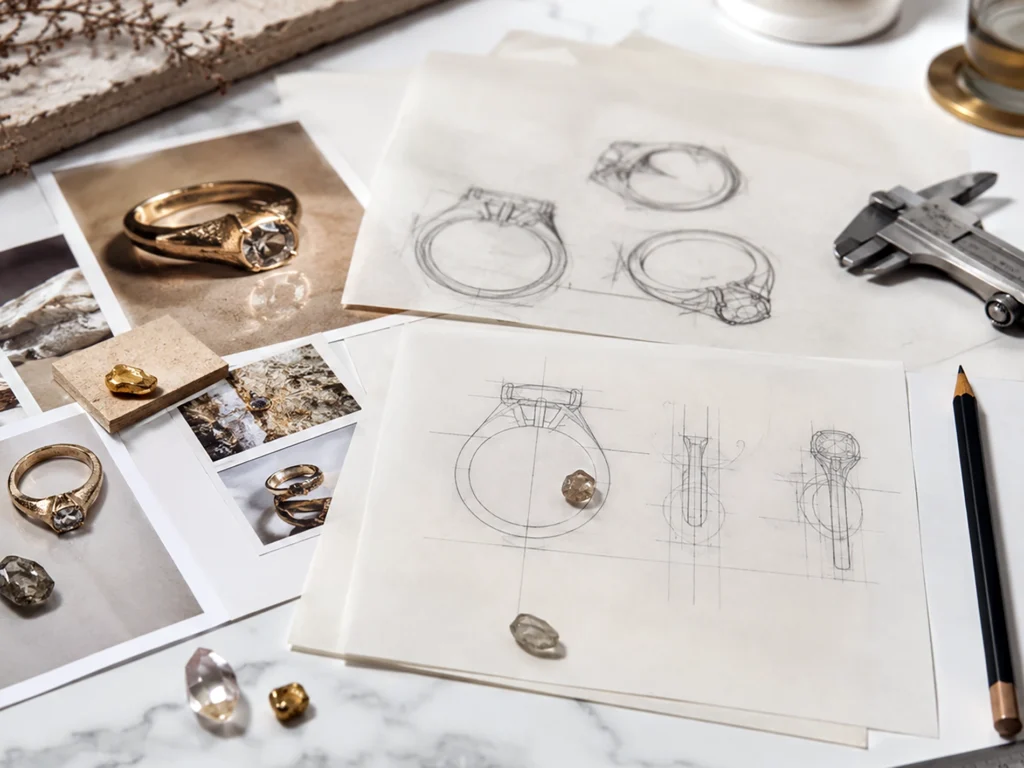
Because of this, when I speak of lost or stolen jewellery, I prefer not to limit myself to the most immediate question: “can it be remade?” The more correct question is: does serious documentation exist that allows that jewel to be protected over time?
In my work, archiving, the identification code, 3D design and documentation are not secondary details. They are part of the guarantees that accompany a narrative or bespoke piece of jewellery.
The fear of losing an important piece of jewellery
There are objects that we check multiple times during the day: phone, wallet, documents, keys.
Something different happens with jewellery. We often realise its deeper value precisely when we fear we have lost it.
A wedding band, an engagement ring or a custom-made piece of jewellery cannot be replaced like just any object. Even when it is possible to create a new version of it, what matters is having a technical and documentary record of the original piece of jewellery.
Without an accurate archive, faithfully reconstructing a complex piece of jewellery can become difficult, approximate or impossible.
The story of Margareth
Some time ago a client from Berlin, Margareth, contacted me along with her partner to create a pair of narrative wedding rings linked to their love story.
I still remember the emotion in their eyes at the moment of delivery.
Shortly before Christmas I received an audio message from him. I thought it was Christmas greetings, but instead it was the story of a misadventure.
Whilst strolling through the Christmas markets, amidst the crowd and bustle of the city, Margareth lost her ring.
At the time I didn't notice a thing. There were loads of people and a huge commotion. On my way home I made the unpleasant discovery.
Margaret was understandably upset. It wasn't just any ring, but a piece of jewellery born from a creative journey, personal significance and the desire to hand down a story.
Why documentation changes everything
In cases like this, it isn't only the skill of the goldsmith that makes the difference.
The difference is made by what was preserved beforehand: design, images, files, technical data, certificates and information linked to the piece of jewellery.
Every narrative piece of jewellery crafted in my workshop can be accompanied by a numerical identification code and an associated documentary archive.
This documentation may include, depending on the type of project:
- preliminary design photos;
- videos or images of the 3D design;
- 3D executive file, when required by the project;
- documentation on gems, if any;
- registration document;
- gemmological certificate, when required;
- materials useful for maintenance or controlled reproduction.
This does not mean promising that every piece of jewellery can always be automatically recreated. It does, however, mean reducing uncertainty and having a much more solid technical basis.
3D files and controlled reproducibility
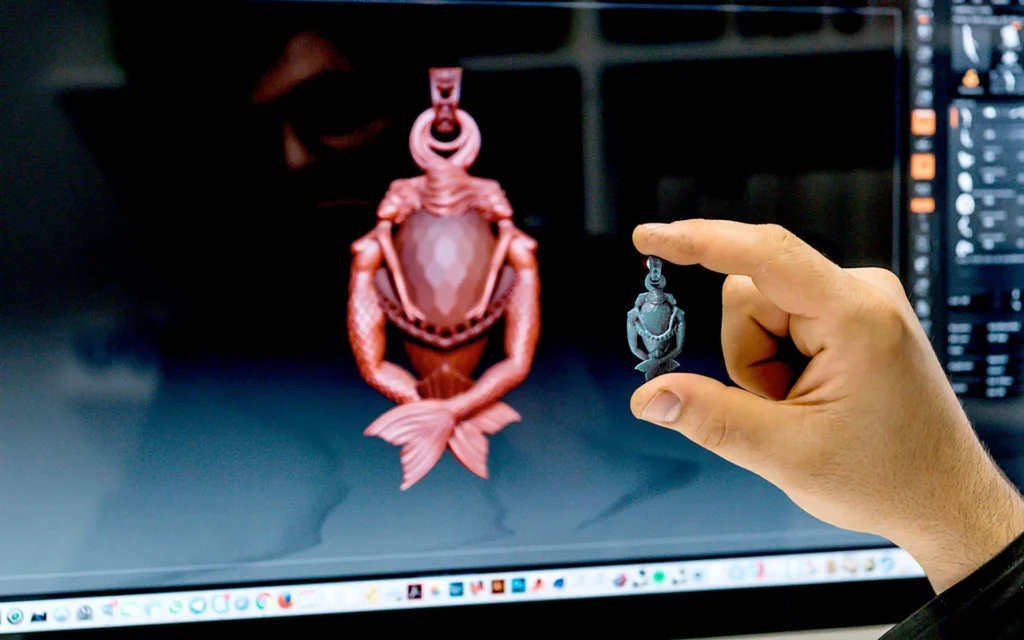
When a piece of jewellery is created through 3D design as well, the production file can become a valuable resource.
In the event of loss, theft or severe damage, that file can help reconstruct the shape, proportions, volumes and details of the original piece of jewellery.
Reproduction remains a process that must always be evaluated with care: one must consider materials, gems, techniques, wear, any variations and the availability of information.
Starting from a proper archive is very different from having to reconstruct a piece of jewellery purely from a photograph or a memory.
In Margareth's case, the retained documentation allowed me to reassure her and start a new build true to the original design.
Lost jewellery: what to do immediately
If you have lost an important piece of jewellery, your initial actions should be methodical and practical.
- Retrace calmly the last places where you wore it.
- Check bags, pockets, cars, the bathroom, the bedside table, the kitchen, and places where clothes are changed.
- Check if the piece of jewellery is covered by insurance or specific documentation.
- Recover photographs, certificates, receipts, any expert reports and technical data.
- Contact the jeweller or the workshop that made it.
- In the event of theft, consider filing a report with the appropriate authorities.
The more complete the documentation, the easier it will be to understand what can actually be done.
Stolen jewel: why certificates and images are important
In the event of theft, the documentation also serves another function.
Photographs, descriptions, certificates, gemstone characteristics, measurements, engravings, hallmarks, identification numbers and construction details can help describe the piece of jewellery more precisely.
This is useful not only for any insurance claims, but also to distinguish a generic piece of jewellery from an identifiable item.
A bespoke piece of jewellery should be accompanied by clear information precisely because it does not originate as an anonymous product.
Archive and guarantees: not just economic value
Safeguarding a piece of jewellery does not just mean protecting its economic value.
In the case of narrative jewellery, the protection also extends to affective, historical and family value.
A piece of jewellery can tell the story of a marriage proposal, a birth, a promise, a memory, a milestone in life, or a loved one.
When it is lost, you don't just lose gold or stone. You risk losing a part of the story.
That is precisely what the archive is for: preserving traces, data, and technical memory, so that the jewel is not entrusted solely to its physical presence.
Why a bespoke piece of jewellery should be documented
A bespoke piece of jewellery requires listening, design, materials, trials, craftsmanship and inspection.
If all this journey remains undocumented, a part of its value remains invisible.
Because of this, I consider it important to hand over to the customer not just the piece of jewellery, but also tools for understanding and protection.
The documentation makes it possible to know what has been produced, with which materials, through which steps and with what characteristics.
It is a form of transparency.
The difference between an anonymous product and a traced piece of jewellery
A commercial piece of jewellery can be beautiful, precious and well-crafted. But it is often harder to reconstruct its history, design and technical details.
A documented bespoke piece of jewellery, on the other hand, leaves a trace.
It is not an isolated object: it is connected to a project, a code, a story, a series of images and information.
This traceability does not eliminate the risk of loss or theft, but it provides more serious tools for dealing with the consequences.
A guarantee for whoever receives the piece of jewellery in the future
Many pieces of jewellery are designed to be handed down.
When a child, granddaughter or heir receives that piece of jewellery, they will be able to know not only its material value, but also the design, the history and the information that accompany it.
This is particularly important for narrative jewellery: memory should not rely solely on oral storytelling which can be lost over time.
A well-constructed archive helps the piece of jewellery to continue speaking even many years after its creation.
My approach
In my workshop, I do not consider a project finished the moment the piece of jewellery is delivered.
Delivery is just one stage of the journey.
An important piece of jewellery must be able to be maintained, checked, documented and, where technically possible, consistently rebuilt or repaired.
This attention is part of my way of understanding goldsmithing work: not just creation, but responsibility over time.
Lost or stolen jewellery: the real point is prevention
When a piece of jewellery has already been lost, one intervenes on what can be done.
But true protection starts earlier.
It is born when the piece of jewellery is designed, documented, photographed, certified and linked to verifiable information.
Because of this, if you are thinking about a bespoke piece of jewellery, you shouldn't just ask what it will look like aesthetically. You should also ask what documents will accompany it, how the design will be archived and what guarantees will be available over time.
Can you elaborate on my approach on the page dedicated to Guarantees and in the one dedicated to narrative jewellery.
To view some examples of bespoke jewellery, you can also visit the section Creations.
The first meeting is intended to clarify the direction, timetable and feasibility. It does not require an immediate decision.