
Recognise a real diamond it does not mean relying on a quick trick found online. A precious gem requires observation, proper tools, expertise and, above all, a qualified expert.
In this article I take you through a clear overview: what a diamond is, what the difference is between a diamond and a brilliant cut, what the 4Cs are, and why, when buying or evaluating a stone, general trust isn't enough. You need a method.
What is a diamond
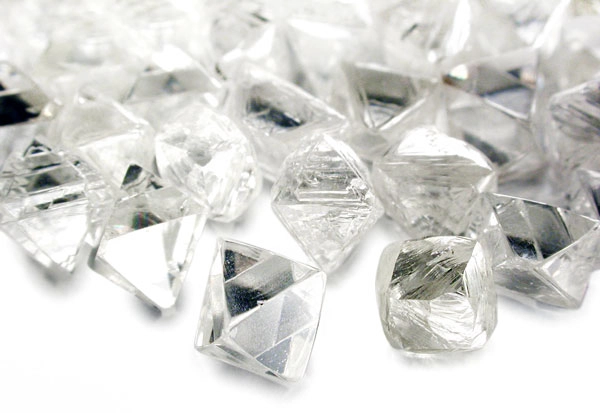
He diamond it is a crystalline form of carbon. Its name is often linked to the Greek term adamas, that is to say, indomitable, invincible, precisely because of its extraordinary toughness.
However, this hardness should not lead one to think that the diamond is a “simple” stone to evaluate. On the contrary, behind an apparently small gemstone lie geological formation, rarity, cut, proportions, inclusions, colour, fluorescence and gemmological documentation.
Why diamonds have value
The value of a diamond depends on several factors. Rarity is important, but on its own it is not enough. The quality of the rough stone, the difficulty of extraction, the selection, the cut, the brilliance, the clarity, the colour and market demand also count.
A diamond is born in extreme conditions, deep down, through very long geological processes. In its rough state, it can seem very far from the luminous image we are used to associating with the finished gemstone.
It is the work of the cutter that reveals its light. A poorly cut diamond can lose much of its potential. A well-cut diamond, on the other hand, returns light, fire and brilliance much more effectively.
The difference between a diamond and a brilliant-cut diamond
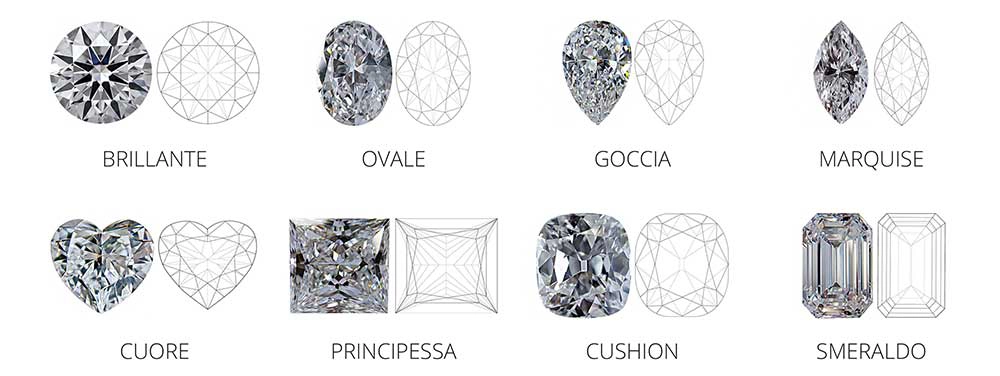
Many people use the words diamond e brilliant as if they were synonyms, but they aren't.
- Diamond state the material, namely the gemstone.
- Brilliant Instead, it refers to a type of cut – more specifically, the round brilliant cut.
The modern brilliant cut generally features 57 or 58 facets, depending on whether or not it has a culet. It is designed to maximise the stone's light return.
This means that one can also speak of a brilliant-cut ruby, brilliant-cut sapphire or brilliant-cut zircon. However, when in everyday language people say “a brilliant” without further specification, they often mean a brilliant-cut diamond.
How to spot a real diamond: the first question
Shouldn't the first question be: “What trick can I use to figure out if it's true?”.
The first question should be: Who’s that in front of me?
Are they a trusted individual or a well-equipped professional? Are they merely a salesperson, or are they also a goldsmith, a gemmologist, an expert appraiser, or a technician capable of reading and verifying the data given in a gemmological certificate?
When buying a diamond, trust is important, but it must be underpinned by expertise, tools and transparency.
The crucial question, then, is: does the jeweller allow me to examine the stone, check the certificate, view the diamond under a microscope and witness key stages, such as the breaking of the seal and the setting?
My assessment method
In my work, I guide the client on a journey of control and awareness. I am not simply interested in delivering a finished piece of jewellery: I want the person receiving it to understand what they are buying and why they can trust us.
The verification can include several steps:
- checking of gemmological documentation;
- microscopic observation;
- verification of stone characteristics;
- colour analysis with touchstones, when necessary;
- fluorescence testing using UV lamps;
- use of scales, callipers and technical instruments;
- checking that the weight, dimensions and certificate are consistent;
- installation of the stone, if required, in the customer’s presence.
This approach does not just serve to confirm the authenticity of the diamond. It also serves to transform the purchase into a more conscious and more secure experience.
The 4Cs of diamonds
To evaluate a diamond, one starts with the so-called 4C, four key characteristics used internationally:
- Colour, that is to say, colour;
- Clarity, i.e. purity;
- Cut, i.e. cut;
- Carat, i.e. calibre.
These parameters should not be read in isolation. A diamond must be evaluated as a whole, because colour, clarity, cut, weight, proportions and fluorescence all contribute to the final quality.
The colour of the diamond
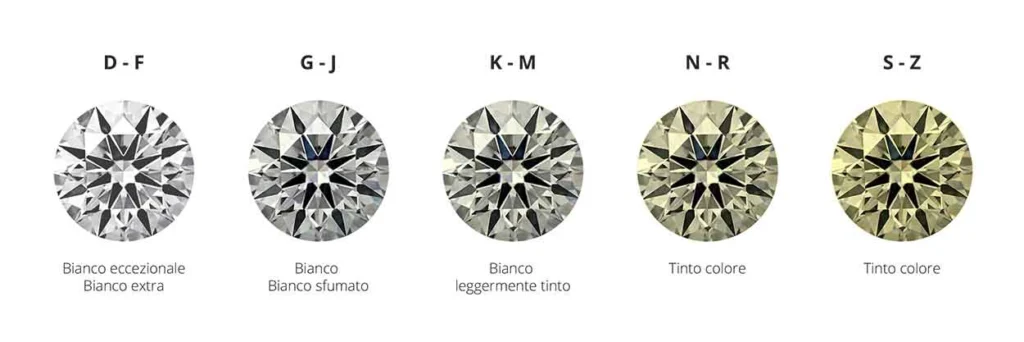
The colour is assessed according to international gemmological scales. The best-known scale is that of the GIA, which classifies diamonds from D, that is colourless, up to Z, with progressively more evident tones.
The more colourless diamonds are generally rarer and more expensive, but the choice does not have to be purely theoretical. One must also consider the setting, metal, stone size and final visual result.
The purity of the diamond
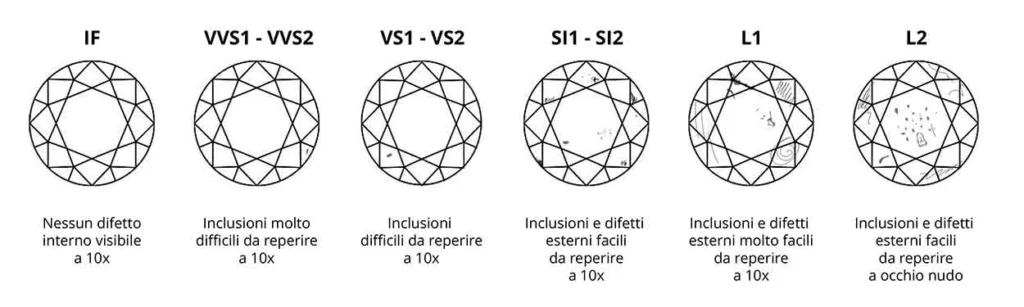
Clarity relates to the presence of internal inclusions or external characteristics visible under 10x magnification by a trained eye.
The main purity classes include:
- FL, Flawless: no inclusions or external blemishes visible at 10x magnification by an expert;
- IF, Internally Flawless: no internal inclusions visible at 10x magnification;
- VVS1 / VVS2extremely small inclusions, difficult to see even for an expert;
- VS1 / VS2very small inclusions, visible with a 10x loupe;
- SI1 / SI2inclusions more easily visible at 10x;
- I1 / I2 / I3obvious inclusions, sometimes visible even to the naked eye and potentially influencing brilliance or integrity.
High purity can heavily affect the price, but it is not always necessary to look for the maximum grade. Here too, the balance between quality, budget, stone size and actual appearance in the piece of jewellery matters.
The diamond cut
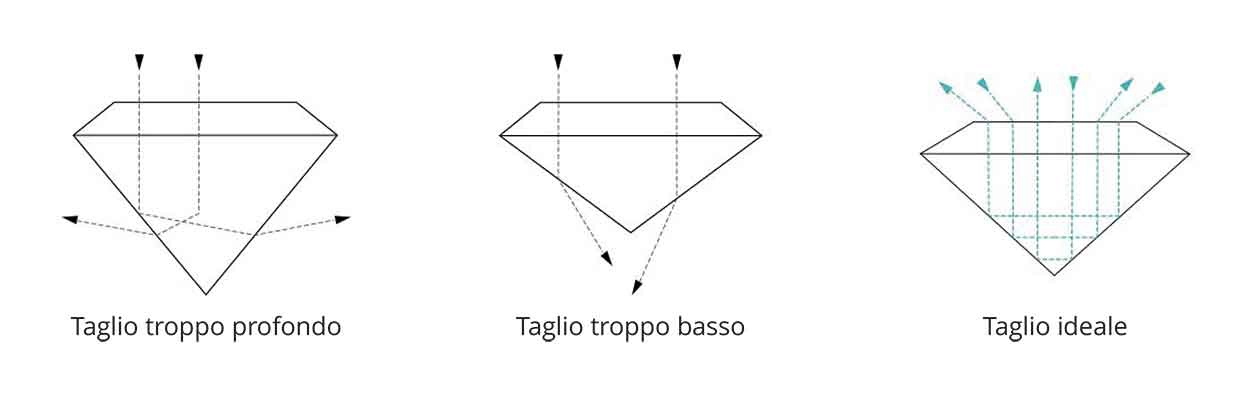
The cut is one of the most important aspects, because it determines the way the stone reflects the light.
A good cut allows light to enter the stone, reflect correctly and exit through the top. If the proportions are wrong, the light can scatter and the diamond appear less brilliant.
- A well-proportioned cut enhances brilliance, fire, and scintillation.
- A canopy that is too low can scatter light downwards.
- An overly deep peak can scatter light laterally.
Some home tests, such as trying to read text through the stone, can generate curiosity, but must not be considered definitive proof. To truly evaluate a diamond, tools and expertise are needed.
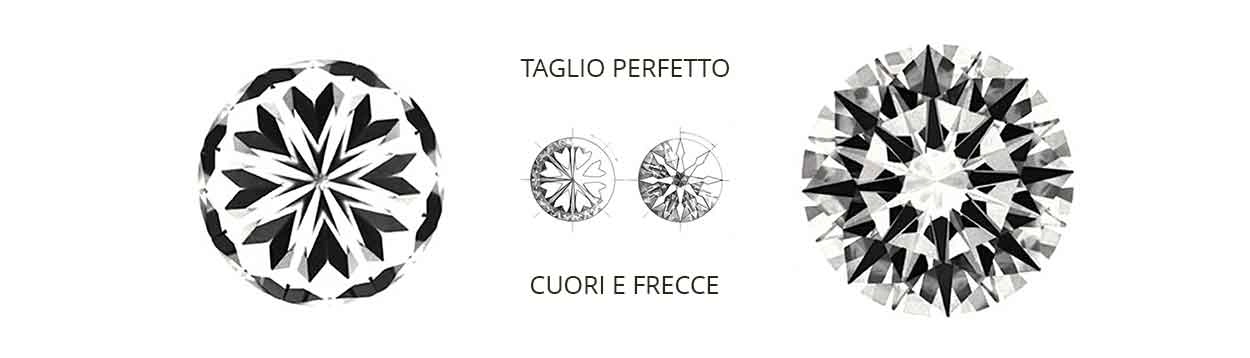
Among the most sought-after cuts for symmetry and visual performance are also diamonds with very precise proportions, such as those known for the “hearts and arrows” pattern, which is visible with specific tools.
The diamond carat weight
The carat indicates the weight of the stone. One carat corresponds to 0.20 grams. The point, on the other hand, corresponds to one hundredth of a carat: a 0.20-carat diamond can therefore also be referred to as a 20-point diamond.
Weight should not be confused with visual size. Two diamonds of the same weight can appear different if they have different cuts, proportions or depths.
Because of this, when checking a diamond, it is important to verify the consistency between the weight, diameter, proportions and the data given in the certificate.

Fluorescence
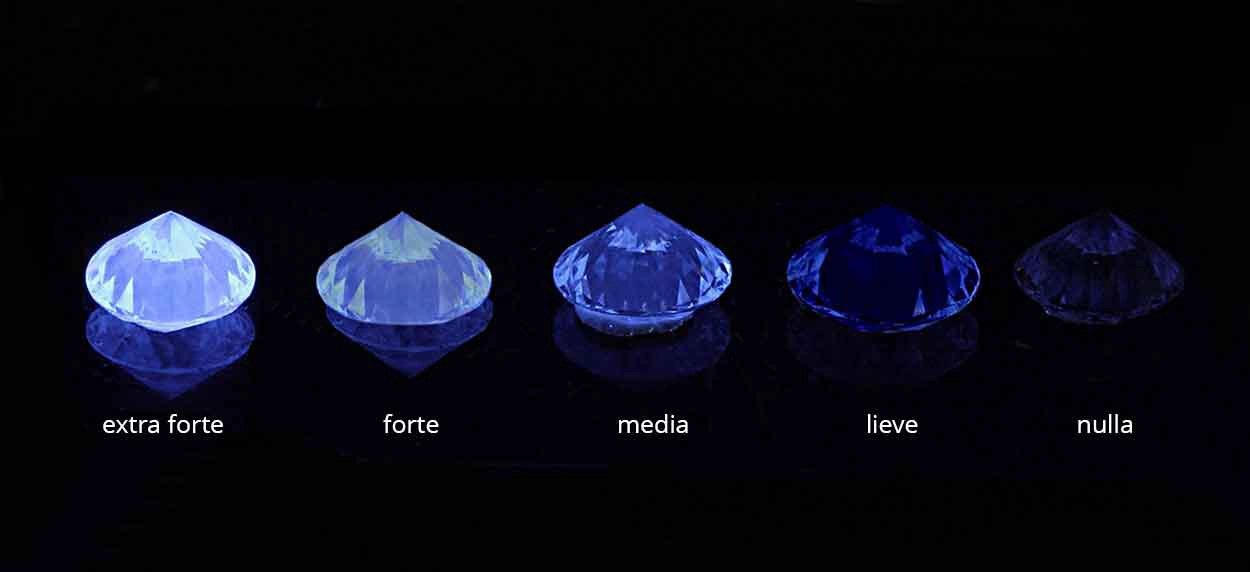
Fluorescence is the phenomenon whereby a diamond can emit visible light when it is exposed to ultraviolet rays.
In gemmological certificates, it can be indicated with different grades, such as:
- none, that is to say absent;
- faint, meaning weak;
- medium, that is average;
- strong, meaning strong;
- very strong.
In many cases absent or weak fluorescence is preferred, but the evaluation must always be made on the specific diamond. Strong fluorescence can affect the appearance of the stone, but should not be judged automatically without observation.
Certificate, expert report and competence
A diamond can have enormous sentimental value, but it can also represent a significant investment. For this reason, it is necessary to purchase or appraise it with great care.
The gemmological certificate is essential, but it shouldn't be treated as a piece of paper to be glanced at distractedly. It must be read, understood and compared with the actual stone.
In addition to my work as a master goldsmith, I also deal with valuations and expert appraisals in the jewellery sector. This allows me to guide the client not only through the creation of the piece of jewellery, but also in understanding the quality of the gemstones and the guarantees associated with the purchase.
The final question, therefore, is not merely: “Is this diamond real?”.
The correct question is: “Who is helping me to verify this, with what tools, with what expertise, and with what transparency?”.
Before buying a diamond
Before purchasing a diamond, I advise you to check a few things:
- presence of a reliable gemmological certificate;
- consistency between certificate and stone;
- reading the 4Cs;
- fluorescence control;
- verification of measurements and weight;
- mount analysis, if the diamond is already set;
- possibility of examining the stone using professional equipment;
- transparency of the professional who is assisting you.
Anyone wishing to buy a diamond for an engagement ring can find out more on the page dedicated to Bespoke engagement rings.
For doubts regarding authenticity, certificates, checks and guarantees, it may also be useful to read the page dedicated to Guarantees.
The first meeting is intended to clarify the direction, timetable and feasibility. It does not require an immediate decision.